

UK manufacturing ended 2025 on its strongest footing in over a year, but beneath the headline growth lies a widening gap between industry giants and the small businesses that form the backbone of the supply chain.
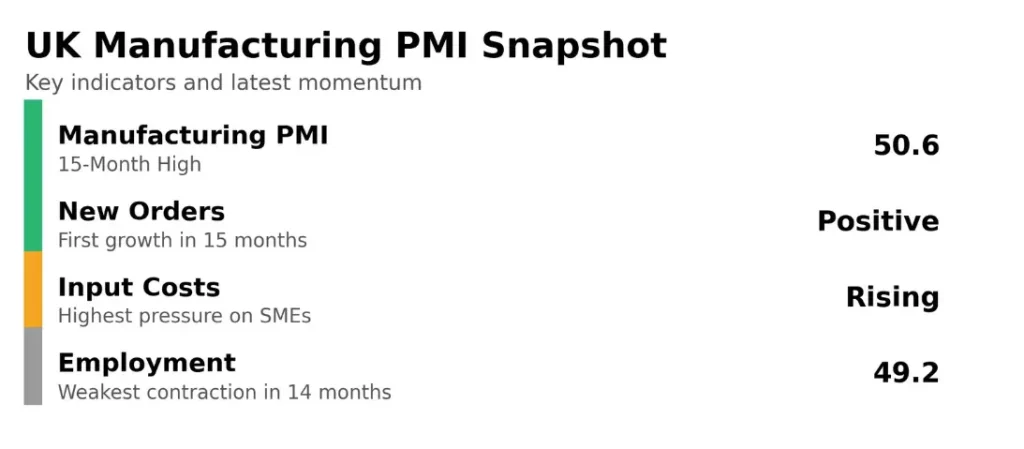
The latest S&P Global UK Manufacturing PMI data, released today, offers a glimmer of hope for a sector that has spent much of the last two years under pressure. The headline index climbed to 50.6 in December, up from 50.2 in November. This isn’t just a marginal improvement; it represents the highest level of expansion since September 2024 and the second consecutive month that the sector has stayed above the neutral 50.0 threshold
Domestic Strength vs. Export Fatigue
The recovery is currently being powered by a resurgence in the domestic market. For the first time since late 2024, new order intakes have moved back into growth territory. While the export market continues its 47-month downward trend, even here there is cause for “cautious optimism,” as the rate of contraction has slowed to its lowest level in nearly four years.
Rob Dobson, Director at S&P Global Market Intelligence, suggests that the manufacturing industry is finally shaking off a series of significant headwinds. The lingering uncertainty following the Autumn Budget, concerns over shifting tariffs, and the disruption caused by the JLR cyber-attack have all begun to moderate. This has allowed manufacturers to pivot their focus back toward clearing backlogs and building the inventory necessary for a more stable 2026.
The Growing Divide: SMEs Under Pressure
However, the headline figures mask a more complex reality on the factory floor. The current expansion is heavily concentrated among large-scale manufacturers. While these “Tier 1” firms are seeing rising output across consumer, intermediate, and investment goods, the picture for small and medium-sized enterprises (SMEs) remains challenging.
Small and medium-sized producers are currently bearing the brunt of accelerating input price inflation. From electronics and energy to metals and packaging, costs are rising sharply, often exacerbated by suppliers passing on higher payroll taxes. Unlike their larger counterparts, many SMEs are finding it increasingly difficult to absorb these costs, leading to a resumption of upward factory gate prices after a brief dip in November.
Navigating the Road Ahead
For sales leaders and business owners, this data suggests a tactical shift for the first quarter of 2026. With business confidence dipping slightly due to high costs and geopolitical uncertainty, the “wait and see” mentality among buyers remains a hurdle.
The recent interest rate cut provides a vital psychological and financial boost, potentially encouraging customers to finally green-light deferred capital investments. However, as the expansion still relies heavily on inventory building rather than raw demand, the focus for Q1 must be on demonstrating undeniable Return on Investment (ROI).
In a market where SMEs are feeling squeezed, sales teams should move away from generic pitches and toward consultative, value-led conversations. Helping customers navigate cost pressures and offering more flexible commercial terms will be the key to maintaining long-term relationships through this fragile recovery.
Rob Dobson, Director at S&P Global Market Intelligence said: “Further signs of growth emanated from the UK manufacturing sector before the turn of the year. Output rose for the third successive month and new order intakes improved, albeit slightly, for the first time since September 2024. The domestic market remained a positive spur to growth while new export business, despite having now fallen for almost four consecutive years, took a sizeable stride towards stabilising. UK manufacturers benefited from several reduced headwinds towards the end of the year, as the negative impacts of the uncertainty surrounding the Autumn Budget, tariffs and the JLR cyber-attack all moderated.”
“The start of 2026 will show if growth can be sustained after these temporary boosts subside. The base of the expansion needs to shift more towards rising demand and away from inventory building and backlog clearance.” – Rob Dobson, Director at S&P Global Market Intelligence
This sentiment echoes views from participants of the roundtable discussions at the recent Manufacturing Revenue Growth Summit. The discussions addressed some of the most pressing industry challenges, with participants focusing on shared solutions across:
- Pipeline Management: The need to clear “zombie deals,” with the insight: “Better a red or green. Never stuck on amber.”
- Talent: Attracting young talent by offering development and purpose, not just job security.
- Customer Retention: Shifting customer success from a department to a mindset, requiring co-creation of success plans.
December 2025: Key Indicators at a Glance
Continued Dobson: “December’s interest rate cut will hopefully play some part in assisting this transition, encouraging manufacturers and their customers to increase spending and investment. Manufacturers remain uncertain on this score, with business optimism falling for the first time in three months in December.”
How is your business preparing for the 2026 manufacturing landscape? Let us know!