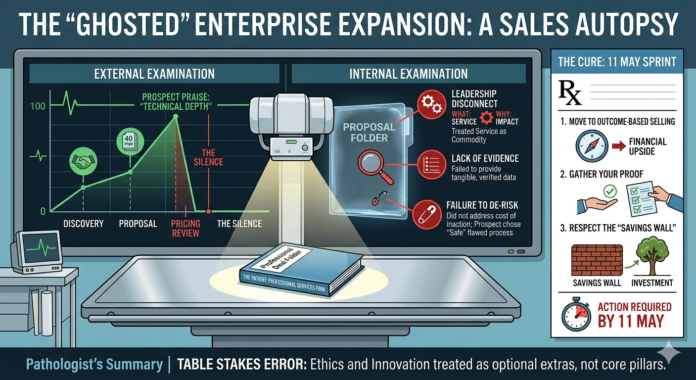
The Patient: A mid-market Professional Services firm.
The Goal: To secure a three-year strategic deal with a Tier 1 manufacturing client.
The Outcome: The prospect went “silent” after the final pitch. Consequently, they chose a competitor with a higher price point.
🔍 Strategic Deal Examination (The Symptoms)
The Engagement: The initial discovery calls were highly positive.
The Proposal: The team provided a comprehensive 40-page deck.
The Feedback: The prospect initially praised the “technical depth” of the solution behind the strategic deal.
The Silence: Communication ceased immediately after the pricing review.
🔪 Internal Examination (The Findings)
The “Leadership” Disconnect
The proposal focused entirely on the what (the service) but ignored the why (the business impact). While the British Business Leaders List highlights pillars like Innovation and Customer Impact, this pitch treated the service as a mere commodity.
Lack of “Evidence-Based” Value
The team claimed they could improve efficiency with the strategic deal. However, they failed to provide tangible, verified data points. In contrast, top-performing leaders use tangible performance data to justify high-stakes decisions.
Failure to De-Risk the Strategic Deal
The prospect was in “save mode,” a common trend where UK households and businesses prefer to guard cash. The sales team did not address the “cost of inaction.” Therefore, the prospect felt it was safer to stay with their current, albeit flawed, process.
🧪 Pathologist’s Summary: The “Table Stakes” Error
The team treated Ethics and Innovation as optional extras. Meanwhile, the UK’s top leaders treat these as the core pillars of their growth. The competitor didn’t win on price; they won because they aligned their sales process with the prospect’s long-term business goals.
💡 The Cure: Prepare for the 11 May Sprint
To avoid this “death by silence,” teams must audit their approach before the National Sales Awards window opens on 11 May.
Move to Outcome-Based Selling: Stop selling features. Instead, start selling the specific financial or operational “upside potential”.
Gather Your Proof: Use the next week to collect verifiable conversion rates and client impact data.
Respect the “Savings Wall”: Acknowledge that your biggest competitor is often the prospect’s desire to save money. Show them that your solution is a better investment than a bank account.