
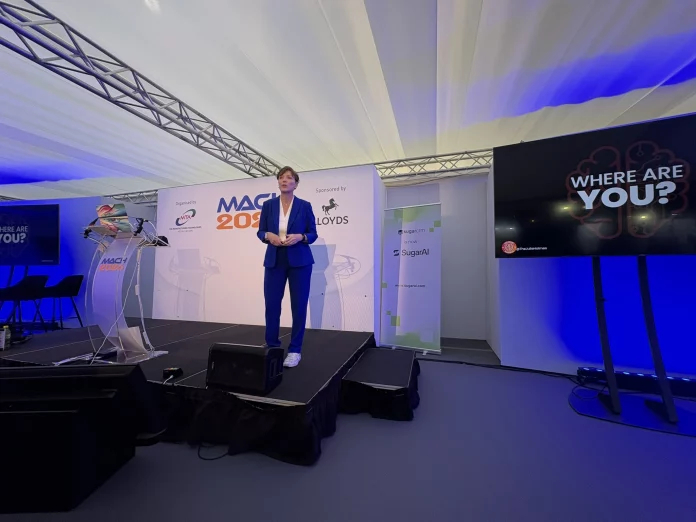
At MACH 2026, Julie Holmes opened the seminar programme with a question about the audience’s feelings toward AI. It divided the room into three types. Specifically, AI enthusiasts who want to “take technology home to meet their parents;” sceptics who are pretty sure this is the Matrix in real life; and people like her next-door neighbour Ruby (who, after a five-minute explanation of Julie’s work in AI, smiled warmly and said, “Gosh Julie, I didn’t know you were so involved with artificial insemination.”)
Ruby, it turns out, represents a significant portion of the working world. And Julie’s message to the rest of us was clear: that is about to change, whether we’re ready or not.
The ‘Rising Floor’ vs. The ‘Second Storey’
Julie’s central argument is that AI has raised the floor for everyone. You can write better copy today than you could a year ago. Better emails, better research, better proposals. But so can every one of your competitors.
“If you’re getting better at it, your competitors are getting better at it as well.”
The organisations pulling ahead aren’t just rising with the floor; they’re building a second storey.
Julie identifies three strategies that distinguish the top performers: building AI literacy and infrastructure within teams, redesigning processes to leverage what AI can uniquely do (not just doing old things faster), and extending into new products, lines of business, and opportunities that simply weren’t possible before.
The One-Slide Primer: Three Ingredients of AI Success
Three ingredients determine what you get out of AI:
The Model: Think of ChatGPT, Claude, Gemini, and Perplexity like ice cream flavours. Each has a different personality. Intermediate users are already using three to four tools depending on the task, picking the right one for the right job.
Context: “The Year of Context.” This is your greatest asset, and it is bigger than most organisations realise. Context isn’t just clean CRM data. It is your hallway conversations, your historical decision-making patterns, and the reasons you gave that discount that nobody documented. The organisations with the richest context will be able to use AI in ways their competitors simply can’t match.
You: The Race Car Driver. Give two people the same Ferrari and the race car driver wins every time. The tool is the same; the expertise, the prompting, and the guidance are what determine the output.
The Framework: 20/60/20
To move beyond “good enough” AI output, the kind that gets scrolled past on LinkedIn or ends with a pastor reading aloud “I can also make this shorter if you’d prefer,” Julie introduced the 20/60/20 Rule. The first 20% is on you to guide the technology, 60% is the machine doing the heavy lifting, and the last 20% is back on you to review, validate, and add the human spark.
The most common mistake? Skipping both 20s. If you’re copying and pasting straight from AI output, you’ve left your fingerprints and your value entirely out of the work.
The PREPARED Prompting Strategy
If you’re not getting the output you want, you’re probably missing something in your prompt. Julie’s PREPARED framework gives sales professionals a structured way to think about this, covering everything from the persona you ask AI to adopt, to the aim behind the communication, to the restrictions, examples, and willingness to discuss and iterate.
The two most commonly missing and most impactful are Persona and Aim. On persona: a dietitian and a personal trainer give you very different answers to the same question. On aim: “write me an email” and “write me an email whose goal is to build enough trust that they reply” will produce entirely different results.
The full framework and how to apply it across your sales process is laid out in Julie’s book, 101 AI Tips, Tools and Prompts.

Standout Ideas for Manufacturing Sales Pros
Break Out of Proximity Bias
Julie opened with a game: write down a piece of furniture. Almost the entire room wrote chair, table, or bed. This is proximity bias; under pressure, we default to the obvious answer. Sales professionals face this every day, and so does the AI they’re prompting.
The fix is to actively challenge your defaults. Ask AI: “What am I missing? Give me three counter-intuitive perspectives on this prospect’s problem.” Don’t outsource your thinking to AI; use it to push your thinking further than it would naturally go.
Build Personas: Meet ‘Reshoring Rachel’
Don’t just research a company; build a persona. Julie’s example of Reshoring Rachel, a procurement manager who has been burned by offshore options and values hard proof over marketing claims, illustrates how a well-built persona transforms every email and proposal. Load the persona into your system once, and every subsequent communication can be tailored to that emotional frequency automatically.
The IKEA Lesson: What Has AI Freed You Up to Do?
When IKEA introduced Billy the chatbot, it handled around 46% of customer service enquiries. Default thinking would cut the headcount. IKEA instead retrained those people as interior design specialists, handling the conversations AI couldn’t. Within a year, revenue had increased by €1.3 billion.
That is the second story. Not “AI does what we used to do, faster,” but “What has this freed us up to do that we couldn’t before?”
Use the Delegation Dial
There are two ends of the dial: mechanical and meaningful. Automate the mechanical (research, summaries, and initial drafts) so you have the energy and focus to be meaningful: the coffee with a client, the complex problem, and the trust that only a human can earn.
“AI cannot have coffee with your client. That’s your job.”
Leadership: Show and Fail
For leaders, Julie’s most actionable advice is to normalise experimentation. People don’t follow instructions; they follow examples. Set aside 10 minutes in your weekly team meeting for Show and Fail: what went wrong with AI this week? What worked? When looking like an idiot is not just acceptable but expected, you create the psychological safety that genuine innovation requires.
The Final Word
Being AI-empowered isn’t just about the technology. Everyone has access to the same tools; the question is whether you’re driving the Ferrari or just sitting in it.
The second-story sales professional knows that AI won’t have coffee with their client, can’t earn trust on their behalf, and can’t replace their lived experience or judgment. But it can handle the data, the research, the drafting, and the analysis so that the human in the room can handle the relationship.
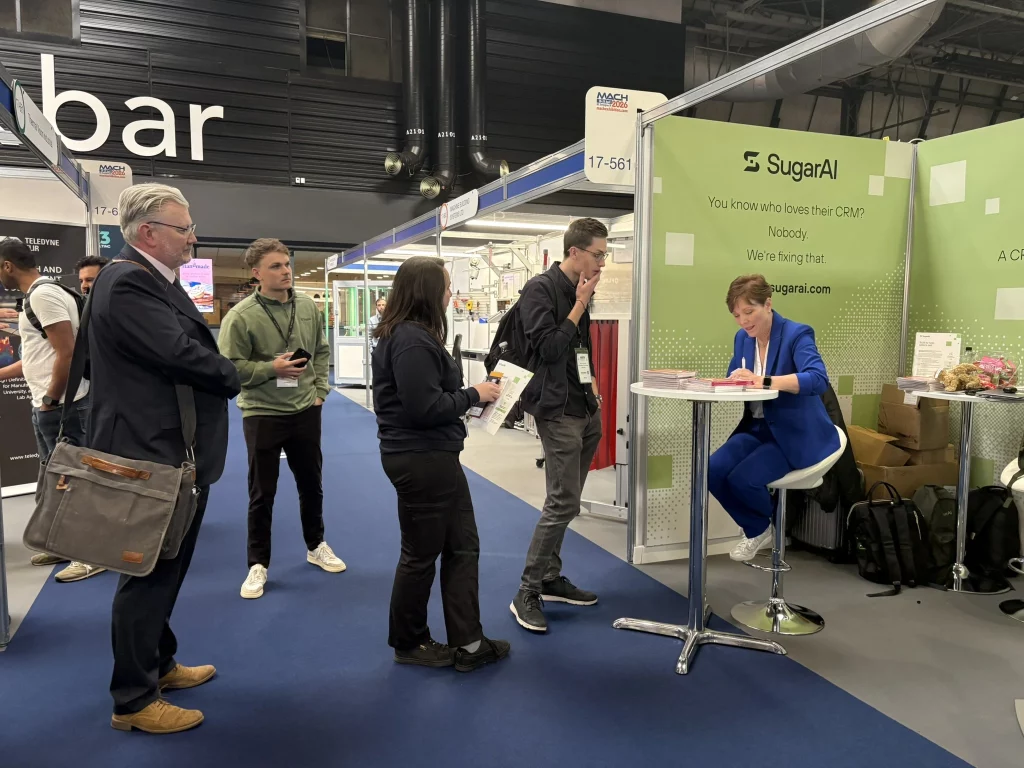
Evidence of the “Second Storey” appetite was on full display afterward, with a significant queue forming for signed books as people looked to put Julie’s frameworks into immediate action.
Want to Build Your Second Storey?
SugarAI brought Julie to MACH 2026 because this is exactly what they help manufacturing and industrial businesses do: move beyond the rising floor and build something their competitors can’t easily copy.
If you’d like to explore what a second-storey AI strategy could look like for your organisation, the team at SugarAI would love to talk. You can also get your hands on Julie’s book, 101 AI Tips, Tools and Prompts, by visiting Stand 17-561 or connecting with the team directly.
Julie’s session was sponsored by SugarAI under the Manufacturing Revenue Growth Summit banner. You can also meet the Manufacturing Revenue Growth Summit team at Stand 18-411.
The floor is rising. The question is what you’re building on top of it.