
The global battle for artificial intelligence (AI) dominance is shifting rapidly from model development to underlying infrastructure. Consequently, tech giants are looking for solutions to the not insubstantial financial burdens of data storage and processing. In a major move, international tech firm Robo.ai Inc. has completed the 100% equity acquisition of UK-founded visual data compression pioneer Neurovia AI Ltd.
Ultimately, this acquisition transforms Robo.ai from a smart hardware business into a foundational AI software platform. Specifically, it highlights how critical British deep-tech innovation is becoming to the global “machine economy.”
Solving the 4K Data Storage Nightmare
Visual data presents a massive hurdle for modern smart cities, autonomous driving networks, and intelligent manufacturing lines. High-resolution video feeds consume petabytes of storage, driving hardware procurement costs to unsustainable levels.
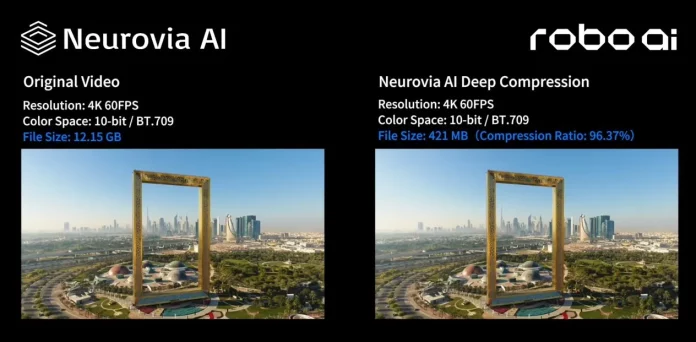
To solve this, the Neurovia AI team developed its core technical architecture, NeuroStream™. The company recently showcased the platform’s capabilities at an international trade exhibition. On-site testing demonstrated that NeuroStream™ compressed a raw 12.15GB, 4K 60fps video down to just 421MB.
Importantly, this represents a staggering 96.37% reduction in storage space. Furthermore, the compression remains completely visually lossless. This ensures the data provides a clean, intact source for machine vision and subsequent AI computations.
Shifting From Human Viewing to Machine Understanding
Most legacy compression formats prepare video for human eyes. Instead, Neurovia AI builds software purely for machine perception. This allows autonomous systems to process, transmit, and react to environmental data at a fraction of the traditional computational cost.
As a direct result of this acquisition, Robo.ai will embed NeuroStream™ as its core data layer. This software foundation will power global deployments across several high-growth B2B sectors:
- Autonomous Mobility: Reducing edge-computing strains for Robotaxis and self-driving delivery fleets.
- Smart Cities: Optimising the data transmission of thousands of urban camera networks simultaneously.
- Intelligent Manufacturing: Streamlining machine vision systems on automated factory assembly lines.
Market feedback confirms that regional governments and commercial users face severe operational burdens from long-term data compliance. Therefore, Neurovia AI has already initiated Proof of Concept (POC) operations with strategic enterprise partners to move the technology into commercial delivery.
“Neurovia AI is not merely an acquisition, but a strategic cornerstone for our long-term development,” stated Benjamin Zhai, Chief Executive Officer of Robo.ai. “Future smart machines will rely on massive data processing. Neurovia AI will serve as the core foundation of our AI software strategy, providing continuous support over the next decade.”
What It Means for UK Deep Tech
This buyout serves as a dual-edged sword for the British technology sector. On one hand, it proves that UK engineers excel at solving the most complex infrastructure bottlenecks in Physical AI. On the other hand, it reflects a familiar trend where a high-value British software asset is swallowed by a Nasdaq-listed entity to anchor its global licensing and SaaS revenue strategy.
Clearly, the transaction underscores a critical truth for growth-focused business leaders. To scale AI effectively, you cannot just focus on user-facing applications. Rather, true commercial value and higher profit margins lie in owning the data infrastructure that makes large-scale automation economically viable.