
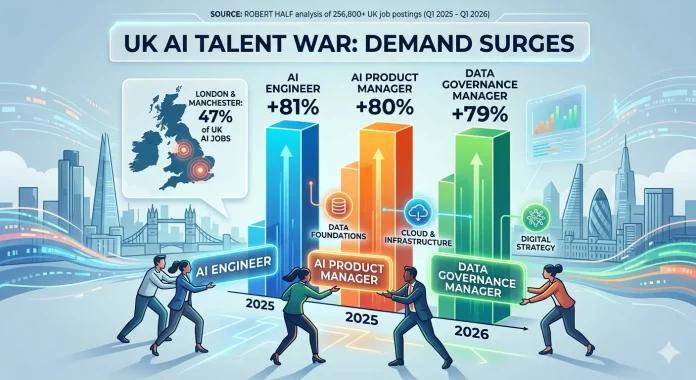
The race to secure specialist technology talent is accelerating rapidly across the UK economy. Specifically, business leaders are moving aggressively from artificial intelligence experimentation to full-scale corporate deployment. This operational shift triggers a major spike in technical and strategic hiring. This trend comes from the latest proprietary job posting database from global talent solutions firm Robert Half.
Consequently, this hiring boom reshapes the UK labour market. Organizations now realize that building a long-term AI strategy requires a highly sophisticated mix of infrastructure, data governance, and specialized leadership.
Technical Delivery and Leadership Demand Skyrockets
The data reveals massive year-on-year growth in highly specialist AI roles between Q1 2025 and Q1 2026. Importantly, the demand spikes are concentrated in positions that bridge the gap between technical code and commercial strategy.
- AI Engineers: Postings surged by 81% as companies build bespoke systems
- AI Product Managers: Demand grew by 80%, highlighting the need for commercial oversight.
- Data Governance Managers: Vacancies spiked by 79% to manage compliance and risk.
Furthermore, demand for Digital Transformation Managers increased by 29%. Machine Learning Engineers also saw a more moderate but steady growth of 24%.
Clearly, this hiring pattern reflects a mature, structured approach to technological change. Businesses no longer fund isolated use cases. Instead, they build permanent internal capabilities to support long-term digital growth.
Solid Infrastructure Remains the Foundation
The rush for AI talent does not mean firms are ignoring core IT systems. On the contrary, the broader technology ecosystem remains incredibly robust. Cloud and Infrastructure, Business Intelligence, and Data Analytics positions totaled more than 16,800 active job postings across the UK in Q1 2026 alone.
Specifically, the business services, IT, and manufacturing sectors led this recruitment drive. This was followed closely by public services, non-profits, and the retail trade.
Ultimately, these numbers prove that leaders understand a critical technical truth. You cannot deploy advanced autonomous agents or predictive models without clean data and scalable infrastructure.
“What we are seeing now is a shift towards a more structured investment in talent,” comments Craig Freedberg, Regional Director at Robert Half. “Companies are hiring not only technical specialists but also leaders who can embed AI into wider business strategy. At the same time, the continued growth in data and cloud roles underlines that AI success depends on having the right foundations in place.”

Geographics and the Skills Bottleneck
This talent war presents a clear geographic challenge for regional businesses. Specifically, the strongest demand for AI roles remains heavily centralised. London and Manchester together account for a massive 47% of all AI job vacancies in the UK.
As a result, regional engineering and manufacturing firms outside these hubs face an uphill battle. They must compete directly with elite urban tech clusters for the exact same pool of specialists.
In conclusion, to secure these vital skills, growth-focused leaders must look beyond traditional recruitment. Companies need a strategic blend of permanent transformation experts, flexible contract talent, and continuous internal upskilling.
Without a coordinated approach to building these data foundations, businesses risk falling behind in an increasingly automated economy.