
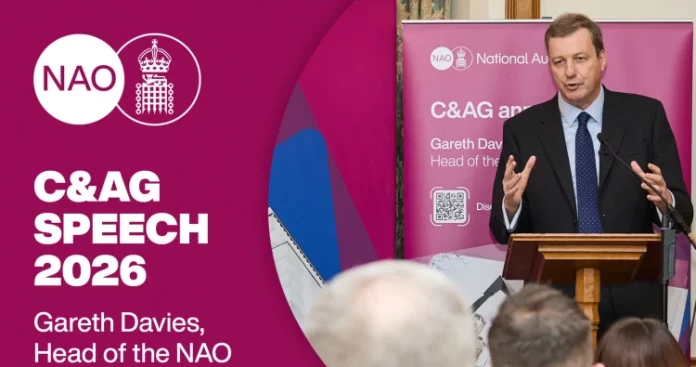
Gareth Davies, head of the National Audit Office (NAO), has issued a warning. A warning that resonates beyond the public sector. Specifically: Too many services remain difficult to use and expensive to deliver. Geopolitical tensions and demand pressures are rising. But, Davies’ roadmap for “Trust, Value, and Impact” provides a masterclass in how any organisation can reclaim its business productivity edge in 2026.
This call for a “step change” in financial management is echoed by the Institute of Chartered Accountants in England and Wales (ICAEW). The institute has long championed the role of professional accountants in tackling issues ranging from public debt to the effective management of the public balance sheet.
Kill the ‘Archivist’ Mentality
Davies identifies a critical weakness. Managers often lack “activity cost information” to drive efficiency. That is because systems are set up to control budgets rather than help people manage. This is a challenge the ICAEW identified more than a decade ago in its A CFO at the Cabinet Table report. The report notes that a focus on spending limits creates a genuine “disincentive to proactively manage costs.”
The Growth Hub Take: If you are only looking at your top-level P&L to stay within budget, you aren’t managing growth. Instead, you’re just archiving history. The goal should be better outcomes for customers, not just balancing the books.
The ‘Iron Man’ Approach to AI
The NAO is taking a “pro-innovation” approach to AI. Therefore, it highlighted cases where AI-enabled tools saved the police 11,000 days a month. It was achievd by automating video redaction. However, Davies warns that accuracy risks must be managed to secure public trust.
The Growth Hub Take: Success in 2026 isn’t about replacing humans with robots; it’s about “Iron Man” augmentation. Use AI for the high-volume “heavy lifting,” but keep your experts in the loop to provide the nuance and conviction that algorithms cannot.
Bridge the ‘Capability Gap’
Davies emphasises that efficiency won’t come from simple “headcount” shifts, but from a surge in specialist skills. Henning Diederichs, Senior Technical Manager at ICAEW, agrees. He says that the public sector needs the “skills and capability needed to support effective financial decision-making.”
The Growth Hub Take: You cannot cut your way to growth. Instead, true operational resilience requires a workforce that views financial information as a tool for performance, not just a compliance checkbox.
Stop ‘Cost Shifting’ and Look at the Whole System
A recurring failure identified by the NAO is the “transfer of cost to another part of the system with no benefit to the taxpayer”. The ICAEW suggests the UK needs a more holistic approach that takes a long-term view of resource allocation rather than reactive, short-term budget fixes.
The Growth Hub Take: This is a trap many scaling businesses fall into. Siloed “efficiency” in sales that creates a bottleneck in operations isn’t a win. It’s a shell game. To grow in 2026, you must analyse the end-to-end journey to ensure one department’s “saving” isn’t another’s “cost”.
The Bottom Line
“Financial management is not just about compliance. It’s how better results are delivered,” says Davies. In an era of chronic under-investment and high volatility, the leaders who win will be those who move from simple budget-balancing to a “culture of continuous improvement.”


 and the ICAEW outline the 2026 strategy for digital transformation and financial management.)