
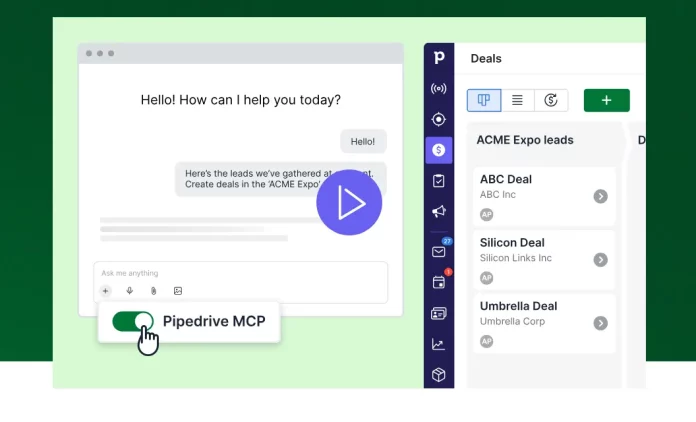
Global CRM provider, Pipedrive has announced the launch of its native Model Context Protocol (MCP) server. As a result, sales professionals will be able to securely connect their live CRM data directly with mainstream AI assistants. Therefore, this will eliminate the need for rep-level data entry and constant app-switching.
By using the open-source MCP standard, sales teams can now query pipelines, create organisations, update deals, and execute multi-step sales workflows using standard natural language commands straight from their preferred AI interface.
Moving Beyond Text Summarisation into Actionable CRM Architecture
The launch reflects a broader industry movement away from passive generative AI tools that just summarise data after the fact. Instead, it is moving toward “agentic” systems capable of executing secure, real-time administrative tasks.
Crucially, the native integration is built on existing user permission logic. Every automated action, record update, or lead conversion performed by an external AI assistant is fully audited and captured in Pipedrive’s internal change logs. This is designed to maintain data integrity and compliance without custom API development or unstable third-party connectors.
7 Core Features Unlocked by the Pipedrive MCP Server
Sales operations and commercial leaders using the server can immediately transition several manual tasks into natural-language automations:
- Conversational Discovery: Searching deals, complex contacts, parent organisations, and fresh leads using casual phrasing.
- Zero-Entry Record Building: Instantly creating and modifying core CRM records without manual form filling.
- Pipeline Transitioning: Converting active inbound leads into structured deals and managing associated follow-up tasks.
- On-Demand Analytics: Generating predictive pipeline insights and forensic sales analysis natively inside the AI chat interface.
- Unstructured Data Processing: Translating raw meeting notes or text transcripts directly into structured, formatted CRM entries.
- Multi-Step Pipeline Orchestration: Automating complex outreach sequences and multi-tiered workflow triggers.
- Scalable Intelligence: Deploying continually evolving agentic capabilities as underlying Large Language Models improve.
Strategic Industry Perspectives
The release signals a fundamental shift in how commercial professionals interact with software architecture. Therefore it places the CRM as a data backbone rather than a destinations-only platform.
“Salespeople increasingly start their day with AI assistants. The question is no longer whether CRM data should be available in those environments, but how to make that access secure, reliable, and genuinely useful,” says Joe Futty, Chief Product and Technology Officer at Pipedrive. “With Pipedrive MCP, we are giving customers direct, secure access to their sales data and workflows wherever work happens. This is an important step toward a future where Pipedrive’s intelligence isn’t confined to a single interface, it’s embedded in every tool, every conversation, and every decision a sales team makes.”
From an integration perspective, deployment specialists emphasise the productivity dividends for front-line sales reps who are traditionally bogged down by data maintenance.
“We used Pipedrive MCP to bring AI directly into the CRM, handling the manual work that used to slow salespeople down, data enrichment, lead discovery, analysis, reminders, automations, and connecting third-party tools. All without leaving Pipedrive,” says Bernd Auer, Pipedrive consultant at PD Experts. “This allows salespeople to focus on what AI still cannot replace: the human side of sales, like reading between the lines, building trust, and closing deals through genuine relationships. MCP will fundamentally shift the relationship between AI and CRM.”
Deployment and Tier Availability
Unlike highly technical enterprise integrations, the Pipedrive MCP server requires no coding skills or developer resources to implement. The system connects seamlessly using a secure OAuth verification process. Pipedrive has made the feature universally available, deploying it immediately across all subscription plans to ensure SMB users can leverage enterprise-grade agentic workflows without additional tier barriers.