
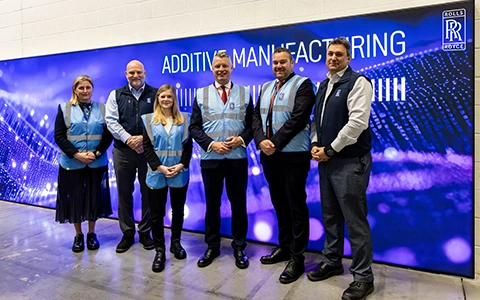
The UK’s aerospace sector has taken a significant step forward. Minister for Defence Readiness and Industry, Luke Pollard MP, officially opened a new Additive Manufacturing (AM) Development Cell at the Rolls-Royce facility in Bristol.
Ultimately, this facility represents more than just new machinery. It is a strategic investment in the future of British combat power and propulsion.
The Tech: German Engineering Meets British Innovation
Funded by the UK Ministry of Defence, the cell utilises advanced 3D-printing technology to manufacture critical engine components. These parts are designed for next-generation aircraft.
Crucially, the technology allows engineers to construct complex parts layer-by-layer using metal super-alloy powders and precision laser beams. As a result, Rolls-Royce can now produce components with significantly reduced lead times and lower costs compared to traditional methods.
Powering the Next Generation
This new cell will play a vital role in the Global Combat Air Programme (GCAP). By producing optimised, lightweight components, future aircraft will benefit from increased power and better fuel efficiency.
Furthermore, the facility is housed in a custom-built, 350 m2 controlled environment. The air pressure, temperature, and humidity are all strictly regulated. Consequently, the team can ensure consistent, aerospace-grade quality for every part produced.
Sustaining Skilled Jobs
Beyond the hardware, this investment is about people. Engineers at the Bristol hub are receiving specialist training to operate the cell. Ultimately, this helps to sustain and create high-value jobs in a region that remains the home of UK military aerospace power.
Minister Luke Pollard MP stated: “This new facility is a clear sign of UK industry investing in the skills and technology we need to stay ahead. It keeps British engineers at the forefront of innovation.”
Sustainability and Efficiency
In addition to speed and strength, the new process is significantly greener. The precision of additive manufacturing ensures that engineers use the exact amount of raw material required. Therefore, there is less waste and lower power consumption throughout the production cycle.
Andy Higginson, Senior Vice President at Rolls-Royce, added: “Capabilities like additive manufacturing will be crucial to enabling innovation at pace and enhancing the skills of our people.”
Precision is the New Currency
At The Growth Hub, we focus on the transition from “mechanical” production to “meaningful” innovation. This Rolls-Royce facility is a perfect example of that shift. By adopting additive manufacturing, the UK is moving away from wasteful, slow traditional processes. Instead, we are embracing a high-velocity, high-precision future that secures our “sovereign capability” in the global aerospace market.