Can a global pandemic be the secret ingredient to becoming the best team on the planet?
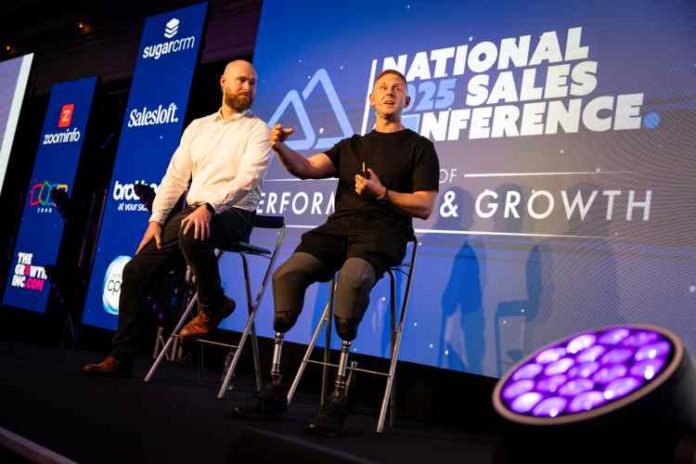
At the National Sales Conference (NSC), three-time Paralympian Aaron Phipps MBE and his performance coach John Cooper shared a story that defied every sports science manual ever written. It wasn’t just about wheelchair rugby; it was about how a “bromance,” a public park, and a total collapse of “expertise” paved the path to gold.
The Goal: “I Want to be the Fastest in the World”
When Aaron Phipps returned to wheelchair rugby in 2017, he didn’t just want to play; he wanted to dominate. He approached John Cooper with a goal that silenced the room: “I want to be the fastest player in the entire world.”
For John, a coach used to elite facilities and established research, this was terrifying. He turned to the data. He searched for research on wheelchair rugby sprint training and found only three articles in the entire world.
“Every training program in my little black book had legs,” John admitted. “We had zero clue where to start. We had to wing it.”
Despite the lack of a roadmap, they spent two years in elite facilities. The result? Aaron broke the 5-second barrier for the 20-metre sprint, a feat never before achieved in the sport. But they still couldn’t beat the world champions, Japan.
The Lockdown Pivot: Throwing Out the Manual
When the Tokyo games were postponed in 2020, Aaron and John were cut off from their world-class facilities. They were forced onto a public path in a local park. They had to sweep up glass and dodge dog walkers to train.
However, this constraint became their greatest competitive advantage. Without the “walls of expertise,” the two were forced into a new level of honesty.
The Power of “We”: They spent two hours on the phone dissecting every player in the world.
Knowledge Exchange: John realised Aaron was the true expert. “He’s the only person in the chair,” John noted. “I had to lean into what he knew.”
Creative Constraints: They discovered Aaron could move his chair using only his hips—a “Beyoncé” move that became a secret weapon for on-court agility.
The “Impossible” Data: 4.52 Seconds
When the world reopened, Great Britain (GB) performance staff were sceptical. “Numbers don’t lie,” John thought. “You don’t get better on a park path than in elite facilities.”
Then Aaron ran the sprint test. He didn’t just break his record; he obliterated it, clocking 4.52 seconds. To put that in perspective, if Usain Bolt had improved by the same percentage, he would have run the 100m in 8 seconds flat.
Aaron went on to smash personal bests in all ten GB fitness tests. The “Path to Gold” wasn’t a metaphor; it was a literal strip of tarmac that had transformed his physiology.
Tokyo: The Moment of Truth
The semi-final against Japan was the hurdle. GB hadn’t beaten them in eight years. Aaron was tasked with marking Ikazaki Dau, the world’s most dynamic player.
“It’s elite sport; it’s not a tickling competition,” Aaron joked.
He shut Dau down completely. GB moved to the final against the USA and won. For the first time in history, a European team had secured Paralympic Gold in wheelchair rugby.
The Uncomfortable Truth: The Gift of the Pandemic
Reflecting on their journey, Aaron shared a startling realization. If the pandemic hadn’t happened, they might have “scraped a bronze.” The disruption forced them to stop playing it safe and start being honest.
The Lessons for Business Leaders:
- Park the Ego: John had to admit he didn’t have the answers to coach a world-class athlete in a park.
- Find Your Path to Gold: Don’t wait for “elite” conditions to start innovating. Use the constraints you have today.
- Use 100% of Your Potential: “I had to lose 30% of my body before I started to use 100% of my potential,” Aaron said.
What is Your Path To Gold Moment?
Aaron and John’s story reminds us that the “Instagram-polished” version of success is rarely the true one. Real growth happens when the facilities are gone, the manual is thrown out, and all you have left is a process, a partner, and a relentless focus on the next play.
The ‘Invisible Sale’: 3 Lessons from Simon Hazeldine
Ben Hanlin: The Psychology Of Sales Audience Engagement
Andy Bounds: Why Your Prospects Don’t Care About Your History