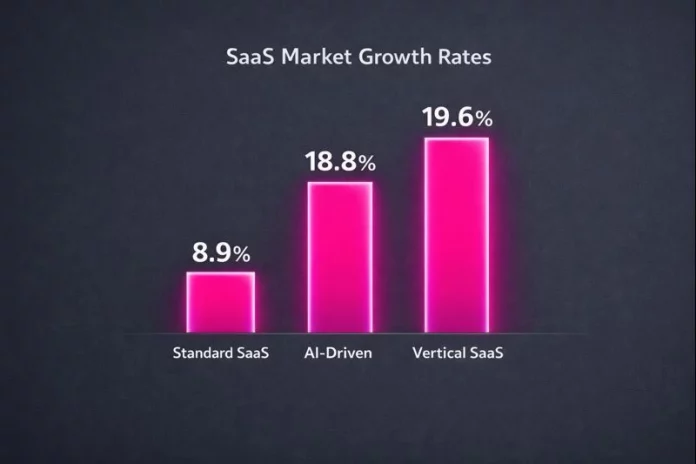
As of early 2026, the SaaS market has moved from a “cloud-first” era to an “AI-everywhere” era. Individual reports vary on the exact CAGR (Compound Annual Growth Rate). However, the consensus is clear. The floor of the market is rising, and the UK is punching significantly above its weight.
The Data Clash: Growth Projections & Market Size
When we look at the leading 2026 reports, we see a slight divergence in the velocity of growth. But, total agreement on the scale (chart, pictured below).
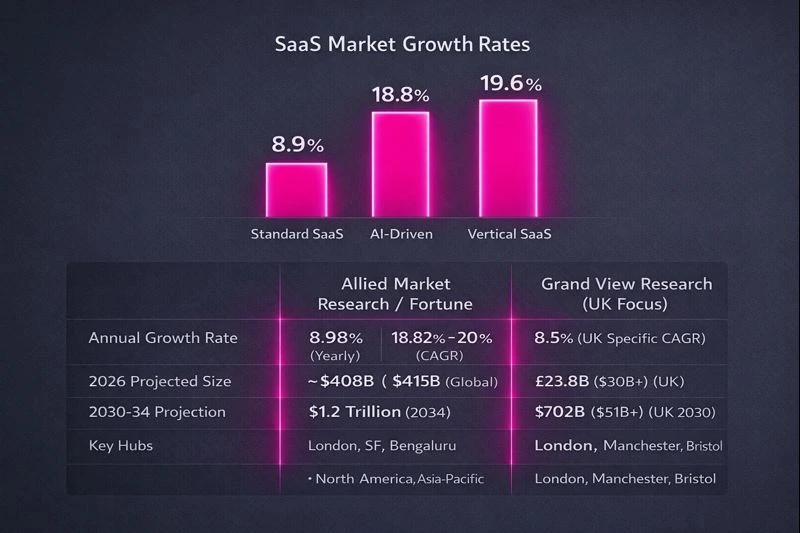
The Conclusion: The “conservative” 8.9% growth from StartUs reflects a mature market consolidating its gains. Meanwhile, the 20% CAGR from Allied reflects the explosive “AI-upsell” potential. For the UK, the data suggests a steady, resilient climb to a £40 billion valuation by the end of the decade.
Key Findings: Comparing the Industry “Levers”
- The “Verticalisation” Consensus: All major 2026 reports identify Vertical SaaS (industry-specific software) as the primary growth engine.
- The Data: Niche-specific solutions are growing 2x faster than general-purpose platforms.
- The Shift: StartUs highlights new leaders in niche areas such as wine pricing (Vinera) and debt management (Fence). Meanwhile, Allied notes the BFSI (Banking, Financial Services and Insurance) sector remains the largest vertical by revenue.
- The Efficiency Crisis: “Shadow IT” and Underutilisation. While companies are buying more SaaS, they aren’t necessarily using it.
- The Waste: Zylo and Tenet reports reveal that 50% of cloud budgets remain underutilised. Organisations were revealed to bebwasting an average of $21 million annually on unused licenses.
- The Security Risk: “Shadow IT” (unauthorised software) now accounts for 22% of all security incidents.
- The AI Integration Reality Check: Is AI just hype? Not according to the 2026 data.
Implementation: Over 52% of SaaS companies have now integrated AI features. - Monetisation: 44% of businesses have pivoted to usage-based or hybrid pricing models to capture the value of AI agents, moving away from the traditional “per-seat” model.
The “Sales Spin”: Translating Data into Deals
Now that we have the data, how do you use it to hit your 2026 quota? This is where we can turn stats into strategy.
Insight A: The “Budget Waste” is your Foot in the Door
- The Data: 50% of cloud budgets are underutilised.
- The Sales Play: Don’t lead with “more features.” Lead with “Consolidation.” In 2026, the best way to win a deal is to show the CFO how your platform can replace three other underutilised tools. You aren’t an expense; you are a “budget optimiser.”
Insight B: Target the “Vertical” Pain
- The Data: Vertical SaaS is growing at 19.5% vs 8.9% for horizontal.
- The Sales Play: Stop being a generalist. If you are selling into the UK’s massive BFSI sector, your pitch shouldn’t be about “collaboration”, it should be about “Regulatory Compliance” and “Automated Governance.” The data shows that the “Vertical Tongue” is the only language that closes six-figure deals in 2026.
Insight C: Trust is a “Closer,” Not an Afterthought
- The Data: Security misconfigurations cause 65% of breaches.
- The Sales Play: Brands that prove their security standards upfront close deals 30% faster. In your first discovery call, don’t wait for the security questionnaire. Proactively share your “Security & Trust” portal. Make the buyer feel safe before they even see the demo.
The Final Conclusion
The 2026 SaaS market is no longer a gold rush, it’s a sophisticated ecosystem.
For the Founders: Focus on the “Rule of 40” (Growth + Profitability).
For the Sales Teams: Your new mission is to move from Feature Seller to Efficiency Consultant. The data tells us that the money is there (a £1.2 trillion global prize), but it is being held by buyers who are more cynical, more security-conscious, and more vertical-focused than ever before.