HVM Catapult Unveils Technology Strategy to Fuel UK Manufacturing Growth

The High Value Manufacturing (HVM) Catapult has launched its 2026 Technology Strategy. This ambitious 15-year framework aims to transform the UK industrial landscape by aligning advanced manufacturing with national economic priorities.

The company developed the strategy alongside more than 150 industry partners. Additionally, it provides a clear roadmap through to 2040. Crucially, the initiative seeks to nearly double annual business investment in the sector, ensuring the UK remains a global leader in innovation.

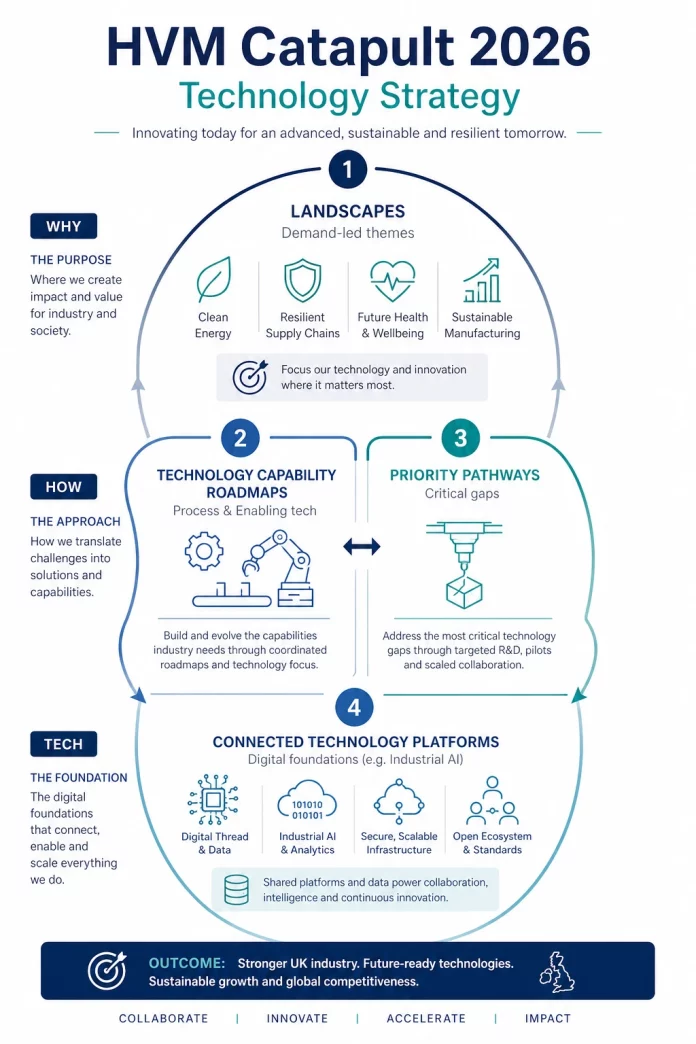
HVM Catapult Technology Strategy: Framework for Success

The new strategy is built upon four interconnected pillars. Specifically, these are designed to bridge the gap between market demand and technological capability.

Understanding the “Market Pull”

At the heart of the plan are Landscapes. These six demand-led themes include Clean Energy and Resilient Supply Chains. Therefore, they represent the real-world needs of industry and society.

Driving Innovation Through Roadmaps

To meet these demands, the HVM Catapult has identified nine Technology Capability Roadmaps. These include six focused on process technologies and three dedicated to enabling technologies. Furthermore, Priority Pathways have been established to target critical capability gaps that require immediate innovation.

Foundations of Digital Excellence

The strategy introduces Connected Technology Platforms. These foundational tools, including Industrial AI and the Digital Thread, provide shared capabilities across all manufacturing domains.

Core Technologies Shaping the Future

The HVM Catapult is prioritising two main categories of technology to drive this industrial transformation.

Transforming Manufacturing Processes

  • Additive Manufacturing: Focused on advancing 3D printing to extend component life cycles and reduce waste.
  • Biomanufacturing: Leveraging biological systems to create sustainable chemicals and green materials.
  • Composites Engineering: Scaling automated production for lightweight materials used in aerospace.
  • Near Net Shape: Using advanced casting and forging to produce complex parts with minimal material loss.

Cross-Cutting Enabling Tools

  • Digital Manufacturing: Implementing data architectures to create agile, connected factories.
  • Robotics and Automation: Developing AI-powered systems for high-mix, low-volume production.
  • Assurance: Moving towards “certification by analysis” to speed up regulatory approval for new products.

Looking Ahead: 2026 and Beyond

The strategy is designed as a “living framework” that will continue to evolve. Consequently, new roadmaps are already planned for 2026.

New Frontiers in Technology

Next year, the HVM Catapult will expand its scope to cover Quantum Technologies, Semiconductors, and AI. These frontier technologies are expected to be pivotal for future growth.

Investing in People

In addition to hardware, the HVM Catapult is focusing on the workforce. Funded by Innovate UK, the “People Roadmapping” initiative will identify the specific skills required to operate these future technologies. Therefore, as the technology advances, the UK workforce is ready to lead.


RECOMMENDED FOR YOU

Sarah Furness – Leveraging Impostor Syndrome for Success

In this Sales Toolkit, Sarah Furness challenges the notion of impostor syndrome being a negative aspect and suggests that it may be inherent to...

Wayve & Uber Secure TfL Licence for London Autonomous Rides

Transport for London (TfL) has now granted Private Hire Vehicle licences to Wayve’s all-electric Ford Mustang Mach-E fleet. As a result, this landmark step brings Wayve and partner Uber much closer to offering commercial autonomous rides across London. In addition, the licensing completes the UK's strict "triple-lock" requirement. Therefore, the operator, driver, and vehicle now all hold matching credentials under the same licensing authority. The vehicles use the Wayve AI Driver alongside cameras and radar, while being supervised by a licensed safety driver. Furthermore, public interest in the technology is growing rapidly. For example, over 100,000 Londoners joined Uber’s Interest List in just eight weeks. Consequently, select riders will take early trips this summer to fine-tune the service before full public launch. The Homegrown AI Revolution: From Lab to Scale Wayve offers a clear case study in commercialising fundamental UK university research. Alex Kendall and Amar Shah founded the company in 2017 out of Cambridge University. However, they quickly set out to break away from traditional self-driving paradigms. Legacy autonomous systems rely heavily on expensive HD maps and rigid rules. In contrast, Wayve pioneered an "AI-first" approach known as AV2.0. Because of this, their AI Driver learns to navigate complex urban streets much like a human driver. Similarly, the system continuously adapts to new vehicle types and changing weather conditions. Having been tested on London streets since 2018, Wayve has subsequently demonstrated driving intelligence across 500 cities worldwide. Sarah Gates, VP Global Affairs & Assurance, said: “This licence is an important step towards giving Londoners the chance to experience autonomous driving technology. The responsible deployment of these vehicles will bring us safer, cleaner and quieter streets, and we’re proud to continue working alongside regulators, communities, and the public as we take the next steps towards making autonomous rides a reality in the capital.” Annie Duvnjak, Global Head of Autonomous Mobility Operations, Uber added: "This licence is a key milestone in bringing autonomous rides to London on Uber. Our interest list has seen an incredible response from Londoners who are excited to experience Wayve’s British-built autonomous driving technology." Commercial Takeaways for The Growth Hub Community Wayve’s success offers valuable lessons for UK firms commercialising high-value R&D: Hardware and Component Opportunities: First, AV2.0 moves autonomous technology directly onto standard production-line vehicles. Consequently, component manufacturers, camera suppliers, and radar specialists have a clear opening to supply automotive-grade hardware. Generalisable Software Drives Scale: Second, Wayve scales rapidly without needing to map every individual street. Therefore, business leaders should evaluate whether their own software architectures rely too heavily on rigid rules. Go-to-Market Alliances Accelerate Growth: Finally, Wayve partnered directly with Uber instead of building a standalone consumer network. Combining novel IP with established commercial channels ultimately speeds up regulatory trust and market access.

Toby Carrington – Revenue Operations in Real Life

The goal of Revenue Operations is to support the unification of all the Go-To-Market teams around a single process aligned with the customer's buying...
- Advertisment -

FEATURED

Rob Hosking – Pathways to Adaptability

Adaptability is a skill we develop over time, often shaped by experiences that push us beyond our comfort zones. It is a universal experience. It...