
When any team comes together and does something really precise or effective, chances are, there is a playbook behind it. Take sports teams as an example. When a particular play comes off, like a free-kick routine, you’ll bet they’ve practised it in training. In football, you often see the corner taker raising their arms to indicate where the ball is going to go, for example.
The playbook doesn’t get the credit it deserves, but it’s a fundamental part of success. When a new player arrives to the sports team, they’ll be required to get up to speed with the playbook. The same happens with a new sales hire. Learn the playbook. It should be one of the first things a new hire does.
Without a sales playbook, how can you expect your team to execute consistent activities?
What is the sales playbook?
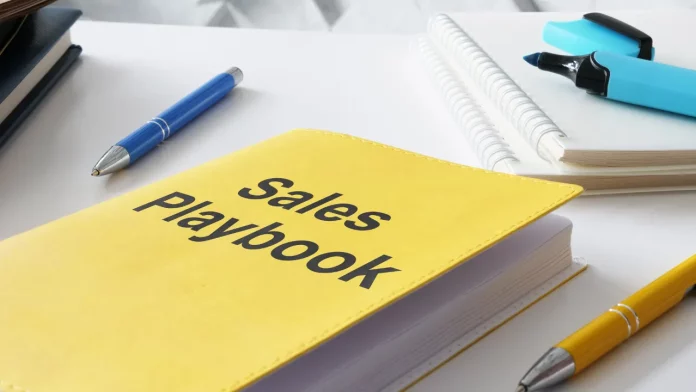
The sales playbook is the product of hours of discussion, prospect insights, research, and internal decisions. It’s a document that outlines what works, and, in some cases, what doesn’t. It should outline every action and process involved in the entire sales process and include how-to sections for those who don’t know. Furthermore, it needs to be all-encompassing, and when new objections, technologies, or best practices come up, it needs to be added or amended in the sales playbook.
And, as carefully as it is put together, it should be studied carefully by every member of the team. If your team is using the same sales playbook, you’ll see more consistent results and avoid rogue salespeople operating outside the box.
Find the most successful approach, document it in the playbook, and ensure your team follows it. Do training sessions on particular parts of the playbook to make sure it’s being learned.
If an employee comes to you with a question, they should be able to find the answer in the sales playbook. If it’s not there, add it. The sales playbook essentially operates as the ultimate sales bible.
Create and circulate
The takeaway is simple. The sales playbook needs to be all-encompassing and far-reaching. Once created, it needs to be circulated on an ongoing basis. Playbooks can be created individually, team-wide, for yourself, for your business, for your customer service teams and more. They need regular testing and updating based on customer or prospect discussions. And your team needs to know they are expected to follow the documentation.
Ideally, the playbook will serve as the operating system of your team. It’s full of actionable items, best practices, how-to guides, and more. And if the whole team is effectively using it, you’ll see more predictable outcomes, increased productivity, and better levels of efficiency.
The playbook is not a one-off document. Leading sales organisations regularly update and review it. Processes regularly become outdated, so the playbook must reflect that. Your team should be involved in the process of creating the playbook as their insights and input are valuable. And the value of them following the playbook needs to be communicated. Ultimately, it is there to help them do things better and sell more.