
The era of conversational, autonomous business has arrived. It is reshaping how companies interact with customers and manage their back-office operations. Specifically, Salesforce has launched its biggest retail innovation in years: Agentforce Commerce.
This unified platform is designed to bridge the gap between shoppers, merchants, and AI apps across B2C, B2B, Point of Sale (POS), and order management.
The shift towards what industry leaders call “agentic commerce” is backed by commercial data. In fact, during the last holiday season, AI influenced 20% of global online sales, driving an incredible $262 billion in revenue. Importantly, a distinct pattern emerged. Specifically, retailers running their own autonomous shopper agents grew sales 59% faster than those on the sidelines. Furthermore, AI-referred traffic converts at an impressive eight times the rate of traditional social media channels.
Action Over Conversation: The Core Philosophy
The primary distinction of this new architectural era is action. For instance, traditional generative AI is built simply to hold a conversation. But, agentic AI actively checks inventory, confirms contract pricing, verifies shipping cut-offs, and closes the transactional sale without human intervention.
By providing a workforce of ready-to-deploy agents grounded in proprietary business logic and customer data, businesses can ensure their products show up seamlessly in new Large Language Model (LLM) channels while keeping the actual transaction on their own properties.
Direct Channel Disruptions: Shopper and Buyer Innovation
1. Storefront Shopper Agents
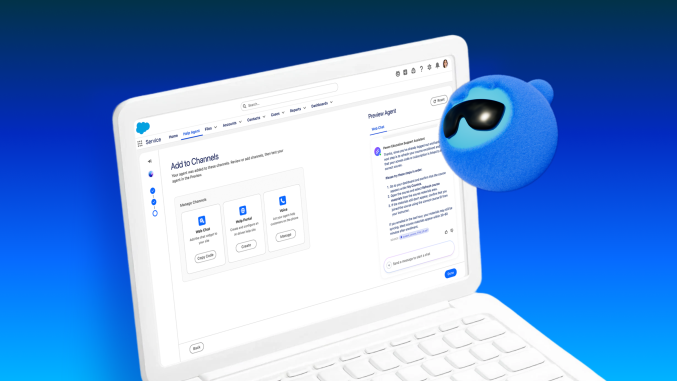
Generally available today, the Shopper Agent brings conversational shopping directly to branded websites while maintaining absolute control over brand voice. So, rather than hitting dead ends with a rigid chatbot, a buyer can ask complex questions such as, “Can I get these trail shoes delivered before my flight Saturday morning?” The agent checks real-time inventory across locations, confirms the carrier cut-off, and closes the deal in a single stream. The system is set to expand to include guest order tracking without an account and intelligent on-page FAQs.
2. B2B Procurement via Messaging
Enterprise buying is inherently complex. However, buyers increasingly demand consumer-grade simplicity. The new B2B Buyer Agent orchestrates the entire procurement journey inside everyday communication tools such as WhatsApp and SMS. A procurement manager at a manufacturing distributor can simply text, “Need 40 cases of the 16-oz fasteners, same as the March order.” The agent returns product images to confirm the SKU, applies specific contract pricing, and finalises the order without requiring a portal login or a phone queue.
Technical Foundations and Architectural Agility
Underneath the user experience sits a major architectural pivot. The platform now operates fully headless as part of Salesforce’s broader Headless 360 vision. Enterprises can use templated front ends on Lightning Web Runtime for fast deployment or build custom React storefronts, partner systems, or specialist AI surfaces while utilizing the identical underlying back end, catalog, and account logic.
Additionally, following the recent acquisition of Cimulate, context-aware AI search is now embedded as Agentic Commerce Search. This discovery engine can run on non-Salesforce sites, reading intent well beyond standard keywords to deliver double-digit improvements in conversion and add-to-cart rates.
“PacSun’s purpose is to inspire the next generation of youth and build a community grounded in innovation and authenticity across every emerging channel,” says Shirley Gao, Chief Digital and Information Officer at PacSun. “We believe the integration of Agentforce Commerce with OpenAI presents a powerful opportunity to extend our products into AI platforms like ChatGPT, transforming conversations into meaningful engagement. With Agentic Commerce Search, we deliver highly relevant, seamless discovery experiences that set a new standard for modern retail.”
Streamlining Back-Office Operations and Physical Retail
The administrative burden of running a multi-channel retail operation is famously cumbersome. The Merchant Agent addresses this by bringing natural-language capabilities directly to the operations team, eliminating manual navigation across multiple admin screens. Teams can now organize catalogs, create boost and bury rules, and tune product sort orders simply by describing what they want. Early testing indicates an 88% reduction in time-to-task metrics.
This structural uniformity extends directly onto the physical shop floor. With a fully unified catalog and order management system, store associates see the exact same stock levels as online shoppers. Store staff can modify or cancel digital or in-person orders from anywhere in the store, removing the traditional barrier between digital teams and brick-and-mortar operations.