The annual sales kick-off ends with applause, the marketing team celebrates a record-breaking quarter of lead generation, and yet, just down the corridor, the sales director is staring at a pipeline full of tumbleweeds. It is a cinematic cliché of corporate life, but it highlights a persistent, painful truth in the B2B world. Here, B2B marketing expert and creator of the bang average marketing newsletter, Scott Addington, reveals why the traditional lead-generation playbook is broken, and explains what sales leaders actually want from their marketing counterparts to drive real commercial growth.
Most sales leaders don’t want more leads. They need fewer bad ones.
That sounds obvious. But, many B2B organisations still measure marketing success through activity metrics. Specifically, more MQLs, more webinar registrations, and more names pushed into Salesforce (other CRMs are available).
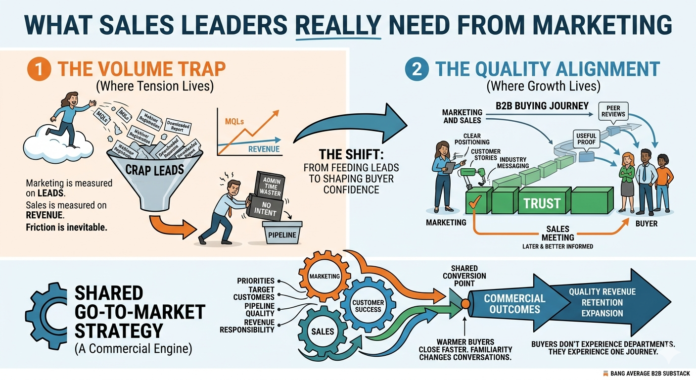
The problem is that the majority of these ‘leads’ are crap. Just because someone signed up for a webinar, or downloaded a report, doesn’t mean they are ready to buy your stuff. In the eyes of sales, these are not prospects that are going to turn into pipeline and sales cycles. Instead, they are just administrative time wasters. And, it is this disconnect that sits at the centre of a lot of the tension between sales and marketing.
The MQL Illusion: Why More Leads Equal Less Value
When marketing is measured on the number of leads they produce, they can easily sit back and celebrate an event or webinar or content syndication programme that has brought in hundreds of ‘MQLs’. Meanwhile, sales are scratching around for anything that looks vaguely like a qualified opportunity, and (not so) quietly questions whether any of what marketing does actually helps them close deals.
To be fair to sales leaders, they are often right to ask the question. Because the real value of marketing has never been about generating a tonne of names. Instead, it is about reducing friction in the buying process and improving the likelihood of revenue. This matters even more when you look at how B2B buying behaviour has changed over the last decade.
Buyers now enter conversations later and better informed. They have already researched competitors, read reviews, watched demos, spoken to peers, and formed opinions long before they ‘request a demo’ or speak to a salesperson.
What Does It Actually Mean to Build Buyer Confidence?
In many cases, sales is no longer introducing the problem or shaping the category. They are joining a buying process that is already underway. Which means the role of marketing should not simply be to ‘feed sales leads’. It should be to help shape buyer confidence before the first sales meeting ever happens.
The companies that understand this tend to approach marketing differently. They invest in the things that make buying easier. Clear positioning, useful proof, industry-specific messaging, credible customer stories, and other forms of content that helps buying groups explain decisions internally.
This is also why some of the old arguments around attribution are starting to feel increasingly outdated. Not every meaningful buying interaction appears neatly inside a dashboard.
A prospect might hear about your company on a podcast, then a few weeks later they may read an article you posted on LinkedIn. They may see your CRO speak at an event, and ask peers in a private community whether anyone has used your product. They may read references from your customers long before filling in a form.
None of those interactions look particularly impressive in a traditional attribution model, but they heavily influence whether a salesperson enters the conversation with trust already established or up against complete indifference.
The best sales organisations already know that warmer buyers close faster. They know that familiarity changes conversations. They know that reputation shortens sales cycles. Modern marketing should be helping create those conditions.
This is also where alignment between sales and marketing becomes far more practical than philosophical. Most misalignment is not caused by personality clashes between departments. It usually comes from both teams being measured differently.
Killing the Silos: Designing One Customer Journey
If marketing is measured on lead volume while sales is measured on revenue quality, friction becomes inevitable.
But when both sides are aligned around pipeline quality, deal progression, retention, expansion, and commercial outcomes, the relationship changes. Marketing starts thinking less about campaign metrics and more about how to help sales win.
The strongest B2B organisations no longer operate with separate sales and marketing plans running in parallel. They operate around a shared go-to-market strategy. That means aligning around the same priorities, the same target customers, the same view of pipeline quality, and the same understanding of where the business can genuinely win. Because buyers do not experience your company in departmental silos. They experience one journey.
When that alignment exists, execution becomes far more effective. Marketing produces messaging that reflects real customer conversations. Sales teams receive support that actually helps move deals forward. Customer success feeds insight back into the wider commercial strategy. The result is not just better internal alignment, but a more consistent buying experience for the customer and a more commercially focused organisation overall.
The companies that will win over the next few years are unlikely to be the ones generating the highest volume of leads. They will be the ones that create the most confidence throughout the buying process. The organisations where sales, marketing, and customer teams operate with a shared understanding of the customer, a shared view of commercial priorities, and a shared responsibility for revenue.
Because, in modern B2B, buyers do not care how your internal departments are structured. They only care whether working with your company feels simple, credible, and low risk.
For more thoughts on modern B2B marketing, GTM strategy, and buyer behaviour, visit the Bang Average B2B Substack at https://bangaverageb2b.substack.com/