
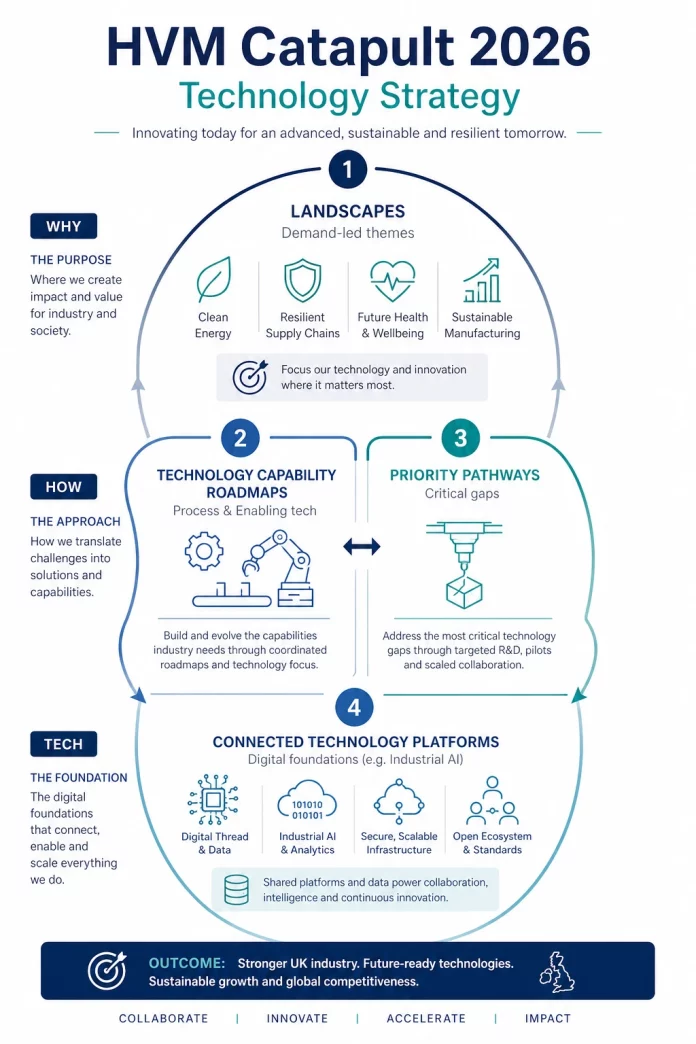
The High Value Manufacturing (HVM) Catapult has launched its 2026 Technology Strategy. This ambitious 15-year framework aims to transform the UK industrial landscape by aligning advanced manufacturing with national economic priorities.
The company developed the strategy alongside more than 150 industry partners. Additionally, it provides a clear roadmap through to 2040. Crucially, the initiative seeks to nearly double annual business investment in the sector, ensuring the UK remains a global leader in innovation.
HVM Catapult Technology Strategy: Framework for Success
The new strategy is built upon four interconnected pillars. Specifically, these are designed to bridge the gap between market demand and technological capability.
Understanding the “Market Pull”
At the heart of the plan are Landscapes. These six demand-led themes include Clean Energy and Resilient Supply Chains. Therefore, they represent the real-world needs of industry and society.
Driving Innovation Through Roadmaps
To meet these demands, the HVM Catapult has identified nine Technology Capability Roadmaps. These include six focused on process technologies and three dedicated to enabling technologies. Furthermore, Priority Pathways have been established to target critical capability gaps that require immediate innovation.
Foundations of Digital Excellence
The strategy introduces Connected Technology Platforms. These foundational tools, including Industrial AI and the Digital Thread, provide shared capabilities across all manufacturing domains.
Core Technologies Shaping the Future
The HVM Catapult is prioritising two main categories of technology to drive this industrial transformation.
Transforming Manufacturing Processes
- Additive Manufacturing: Focused on advancing 3D printing to extend component life cycles and reduce waste.
- Biomanufacturing: Leveraging biological systems to create sustainable chemicals and green materials.
- Composites Engineering: Scaling automated production for lightweight materials used in aerospace.
- Near Net Shape: Using advanced casting and forging to produce complex parts with minimal material loss.
Cross-Cutting Enabling Tools
- Digital Manufacturing: Implementing data architectures to create agile, connected factories.
- Robotics and Automation: Developing AI-powered systems for high-mix, low-volume production.
- Assurance: Moving towards “certification by analysis” to speed up regulatory approval for new products.
Looking Ahead: 2026 and Beyond
The strategy is designed as a “living framework” that will continue to evolve. Consequently, new roadmaps are already planned for 2026.
New Frontiers in Technology
Next year, the HVM Catapult will expand its scope to cover Quantum Technologies, Semiconductors, and AI. These frontier technologies are expected to be pivotal for future growth.
Investing in People
In addition to hardware, the HVM Catapult is focusing on the workforce. Funded by Innovate UK, the “People Roadmapping” initiative will identify the specific skills required to operate these future technologies. Therefore, as the technology advances, the UK workforce is ready to lead.