
We are in the midst of a four-day-weekend (and two four-day-weeks) in the UK right now, due to how this year’s Easter Bank Holiday has fallen.
It got us talking about how the “four-day week” is now not so much a radical experiment for startups. Instead, it is becoming a competitive necessity in the 2026 talent war. But, for manufacturing and tech firms, the fear is real: How do we maintain output when the machines (and the people) are idle for 24 hours more than the competition?
The answer isn’t “working faster.” It’s operational compression. If you want to move your team to a 32-hour week without a 20% hit to your top line, you need to master the 80/100/100 Rule: 80% of the time, 100% of the pay, but 100% of the output.
Here is a “No-Fluff” blueprint to making it work:
The ‘Single-Tasking’ Mandate
Multitasking is a productivity myth that costs the UK manufacturing sector millions. Switching between a technical drawing and a sales forecast costs the brain 20 minutes of “re-focus time.”
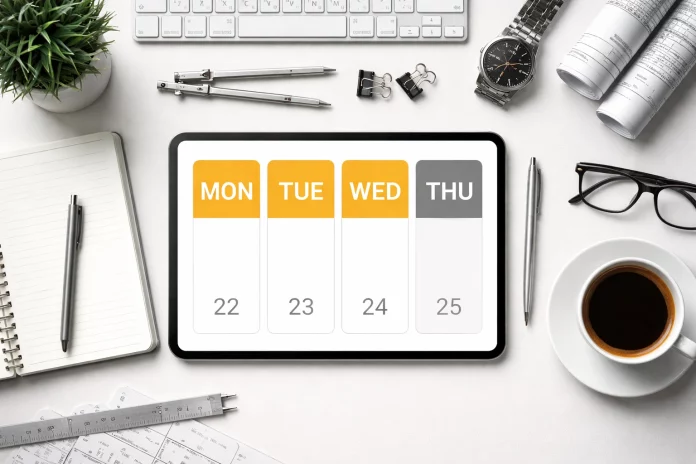
The Productivity Hack: Batch your days. Monday for Internal Operations. Tuesday for Client Facing. Wednesday for Deep Innovation. Thursday for “The Close.” By eliminating the “switching tax,” you reclaim the lost Friday by lunch on Wednesday.
The Verdict: It’s a Capacity Test, Not a Holiday
In short, the four-day week is the ultimate stress test for your business processes. If you can’t make it work, it’s not because you don’t have enough time—it’s because your processes are “leaking” productivity.
Therefore, before you cut the hours, audit the “drag.”
Kill the ‘Status Update’ Meeting (The Silent Tax)
The average mid-sized engineering firm spends 15% of its collective time in meetings that could have been an automated dashboard.
The Productivity Hack: Implement “Asynchronous Alignment.” Use AI-driven tools to provide daily automated briefings on project status. If a meeting doesn’t have a pre-circulated “Decision Requirement,” it is deleted. In a four-day week, minutes are currency.
The ‘Deep Work’ Lockdown
In a five-day week, we tolerate “shallow work” such as answering non-urgent emails and Slack pings. In a four-day week, this is fatal.
The Productivity Hack: Adopt “Golden Hours.” From 09:00 to 11:00 every Tuesday and Thursday, the entire office (and shop floor management) goes into “Radio Silence.” No calls, no internal emails, no “quick chats.” This is for high-value engineering, complex sales strategy, and boardroom alignment.
Leverage the ‘AI Shadow’
Our State of Sales 2026 report found that 63% of firms are now implementing AI, yet many use it as a glorified spellchecker.
The Productivity Hack: Every employee should have an “AI Shadow”—an automated agent handling the administrative “drag” (scheduling, CRM entry, data cleaning). If your team is spending Friday’s lost hours on admin, you haven’t automated enough.
Want to know more? Come to see the Manufacturing Revenue Growth Summit team at Stand 18-411 at MACH 2026. You can meet the people who understand the right tools to make the four-day week a reality.