
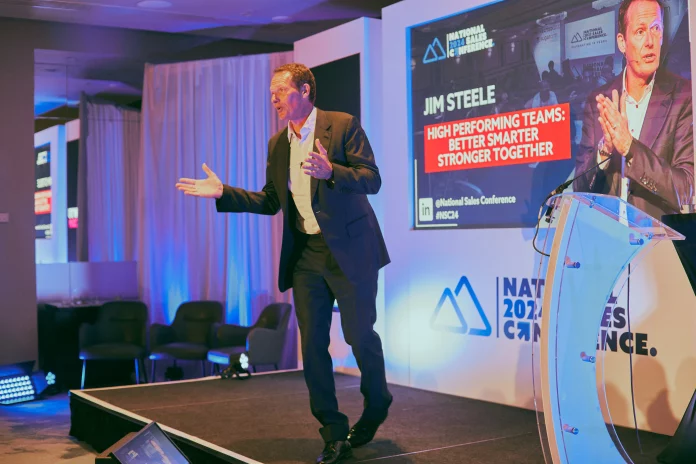
When Jim Steele, author of Unashamedly Superhuman, took the stage at the National Sales Conference, he didn’t start with a lecture on KPIs, pipeline management, or leadership influence. Instead, he started with a lie.
Steele presented the audience with four simple shapes: a square, a triangle, a circle, and a lightning bolt. Then, he gave them seven seconds to choose the one that best represented their personality. After “revealing” the deep psychological profiles of each (the visionary triangle, the collaborative circle), he dropped the bombshell: He had made it all up.
Leadership Influence: The Illusion of Certainty
The exercise wasn’t just a prank; it was a masterclass in the Illusion of Certainty. Steele pointed out that because he had the stage, the slide deck, and the “clicker,” the audience was primed to believe him.
“As a leader, you have that same clicker in life,” Steele told the room. “You have the track record and the authority. You have the ability to influence the way people think, and if you can influence what they think, you can influence what they do.”
The “Comfort Trap” in 2026
Steele transitioned from the psychology of influence to the biology of performance. Citing research from Zenger and Folkman, he noted a startling paradox: while teams consistently rank “inspiring and motivating others” as the most desired leadership trait, it is the competency leaders score lowest on.
The culprit? Our biological hardwiring for comfort
Steele introduced a sobering statistic: 95% of people will never sprint again after the age of 30. Why? Because sprinting is uncomfortable. “The more aggressively we pursue comfort, the faster we age, professionally and personally,” Steele warned.
Sprinting into the Discomfort Zone
In a sales environment, the most “Income Producing Activities” (IPAs), prospecting, pitching, and handling rejection, all live on the “uncomfortable” side of the ledger.
Steele used cold water immersion as a metaphor for modern leadership. We know the data-backed benefits (dopamine spikes, reduced inflammation, mental clarity), yet our brains scream “danger” because the water is cold.
“High-performing teams are those that have learned to ‘sprint’ into that cold water,” Steele explained. “They don’t wait for the discomfort to disappear; they build the resilience to thrive within it.”
Jim Steele’s session was a reminder that leadership in 2026 isn’t about removing friction for your team; it’s about inspiring them to embrace it. If you are using your authority (your “clicker”) merely to keep your team comfortable, you aren’t leading a high-performing team, you’re managing a group that has stopped sprinting.
Check out our other From the NSC Stage articles, including:
The ‘Invisible Sale’: 3 Lessons from Simon Hazeldine
Ben Hanlin: The Psychology Of Sales Audience Engagement
Andy Bounds: Why Your Prospects Don’t Care About Your History