
By 2028, artificial intelligence (AI) agents will outnumber human sales reps by ten to one. However, fewer than 40% of sellers expect these digital tools to boost their daily productivity.
This stark warning comes from technology research firm Gartner, Inc. Specifically, the analyst firm cautions that deploying autonomous AI without a clear strategy risks creating digital noise rather than commercial growth.
“Sales organisations are moving quickly toward a future where AI agents are embedded across commercial teams,” explained Dan Gottlieb, VP Analyst at Gartner. “Crucially, more agents will not automatically mean more revenue. Without the right data foundation and workflow design, sales leaders risk creating agent sprawl. Consequently, they will see more digital activity, but very little improvement in seller impact.”
The Sales Productivity Paradox
Currently, commercial organisations are trapped in a frustrating productivity paradox. Companies continue to expand investments in talent, software, and process updates. Yet, these heavy expenditures continue to yield stubbornly flat returns.
In fact, a recent Gartner survey of 210 Chief Sales Officers (CSOs) highlights this growing disconnect. Remarkably, 60% of sales leaders believe their revenue performance is driven by factors outside their direct control.
To bridge this gap, sales leaders must fix the core systems that support AI tools. Indeed, Gartner predicts that CSOs who overhaul data, automation, and user experience will be five times more likely to gain ROI from AI by 2028 compared to those seeking quick fixes.
“AI agents should not be viewed as a shortcut to productivity,” Gottlieb added. “They are only as effective as the systems they operate within. Therefore, if those systems are fragmented, the agents will simply scale that fragmentation.”
3 Strategic Actions to Prevent ‘AI Agent Sprawl’
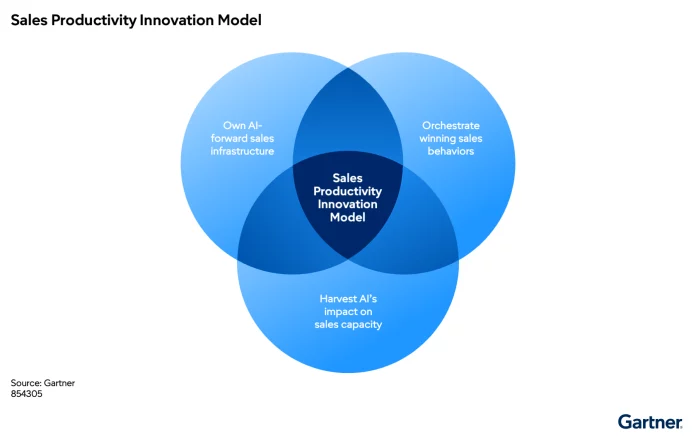
Fortunately, sales leaders can avoid multiplying administrative friction. To do so, Gartner recommends focusing on three core operational pillars:
1. Build an AI-Forward Infrastructure
First, build a centralized context layer. This system should connect enterprise data, core CRM software, and human seller judgment. As a result, AI agents will generate relevant, enterprise-specific outputs rather than generic answers.
2. Orchestrate Winning Behaviours
Second, use AI to reduce administrative tasks. Furthermore, deploy these tools to package top-performer expertise across the wider team. This provides managers with actionable data to improve coaching quality.
2. Measure Expanded Commercial Capacity
Finally, look beyond basic time-saving metrics. Instead, measure how AI agents expand total selling capacity, improve deal velocity, and drive measurable top-line growth.
“Sales leaders should be asking where agents can remove friction, improve decision quality, and create capacity, not simply where agents can be deployed,” concluded Gottlieb. “The organisations that get this right will not just have more AI in the sales function. They will have a better sales system.”
Master the Future of AI in Sales at the National Sales Conference
Are you looking to navigate AI integration, overhaul your commercial tech stack, and drive sustainable pipeline performance in the year ahead?
Join us at the National Sales Conference in January! Connect with leading commercial strategists, explore modern sales enablement frameworks, and learn how to build high-performing, tech-enabled sales teams.
Book your place at the National Sales Conference in January today to secure early allocation for your revenue leadership team!