
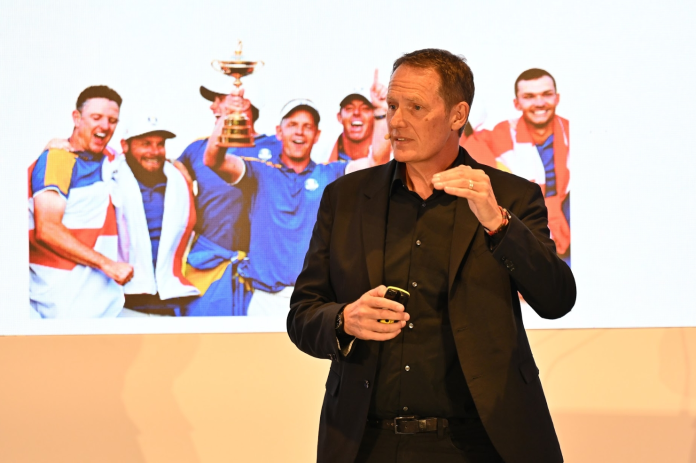
When market dynamics shift, high-performing organisations do not simply work harder; they adapt faster. Speaking at the National Sales Conference, award-winning author and high-performance expert Jim Steele explored what separates resilient organisations from those struggling to keep pace, presenting a practical framework for leading teams through uncertainty.
Unpacking Human Potential
Most leaders acknowledge that their teams rarely operate at 100% of their true potential. However, bridging the gap between current output and maximum capability requires moving past historical benchmarks.
Drawing on research into high-performing teams, Steele highlighted that the most innovative organisations set their vision based on future potential rather than past performance.
“There’s way more to you and I than meets the eye. The system’s already built in; getting access to the systems is sometimes the challenge.”
Activating the Seeking System: When leaders establish clear, unambiguous intent, it triggers the brain’s natural focus mechanisms. As Steele noted, “Once the seeking system switches on with this clarity of intent over our direction of travel, people start to notice things that otherwise they completely miss.”
Clarifying the Abstract: Future-facing strategies are inherently abstract. If a team cannot visualize their specific role within that vision, engagement drops: “If I can’t see why we’re doing it, if I can’t see my role within it, if I can’t see a route through… I’m demotivated in that conversation.” Leaders must actively break down complex strategic goals into accessible, actionable steps, remembering that “clarity around that is better than no clarity.”
Shift from Platitudes to Process
Maintaining a high-performance mindset under pressure is rarely achieved through generic encouragement. Telling sales teams to “be positive” during difficult commercial periods offers zero operational value. High-pressure environments demand clear, repeatable processes. “What I need is a process… I wanted a strategy, not some strapline.”
Ditch the Slogans: Motivation fluctuates, but process endures. Steele posed the key challenge for sales leaders: “How do you get into an optimum frame of mind when the pressure is on? What’s the strategy that you use to help your people shift their mindset under pressure?”
Anchor Focus Under Fire: Simple physical or visual routines help teams reset their focus quickly during stressful sales cycles, preventing reactive decision-making.
Control the Internal Environment: When external market conditions remain unpredictable, focusing on internal execution discipline stabilizes team output. Steele emphasised, “If we know how that happened, if we know what the strategy was to make it work, we can duplicate the performance.”
Redefining Organisational Resilience
Resilience is frequently misunderstood as passive endurance or sheer grit. However, treating tough market conditions as a prolonged stamina test leads directly to burnout and diminished returns. “The quicker you can enable someone to adapt, the less they have to endure.”
True resilience centers on speed of adaptation. By creating an environment where teams can rapidly iterate, learn from friction, and pivot strategies, commercial leaders significantly reduce the time spent struggling against market headwinds.
Key Action Points for Commercial Leaders
Base Targets on Capability: Evaluate your team’s strategy against future market potential rather than adding incremental percentage increases to last year’s figures.
Provide Mental Playbooks: Ensure your account teams have clear, step-by-step frameworks to maintain focus during complex deal cycles.
Prioritise Velocity of Change: Track how rapidly your organisation responds to market feedback, aiming to minimise the endurance phase through swift, informed pivots.
Book your place at the National Sales Conference today to secure places for your sales and leadership team.