
The sudden shift into the AI era has raised the commercial baseline across every industry. Yet, amidst all the rapid tech updates and endless automated workflow options, one key factor continues to dictate success: strong, active sales leadership.
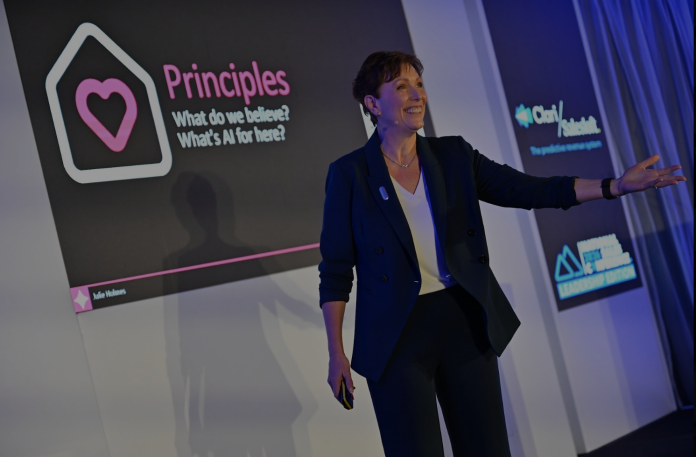
Speaking at the National Sales Conference, tech founder and enterprise technology expert Julie Holmes outlined how commercial leaders can move beyond basic tech adoption to become true “AI Architects.”
Opening her session, Julie highlighted something that many tech-focused teams overlook: “Even the most sophisticated neural network cannot overcome an indifferent team leader.”
Here are the key takeaways from Julie’s presentation on overcoming AI sprawl, shifting the leadership mindset, and building high-performing, tech-empowered sales teams.
The Rising Baseline: Why “Good” Work No Longer Cuts It
Two years ago, when assessing corporate technology readiness, around 60% of organisations believed AI would fundamentally reshape their commercial operations. Today, that figure sits at virtually 100%.
However, as hands-on adoption becomes second nature, Julie pointed out that the barrier to entry for standard commercial outputs has dropped dramatically. “Good has never been easier to produce, but good has also never been less impressive. A junior rep can now generate a cold email that reads like it was written by a 20-year sales veteran. When everyone has access to the exact same baseline tools, doing ‘good’ work won’t win deals.”
The core risk facing commercial organisations today is not becoming obsolete overnight; it is becoming ordinary. When messaging relies entirely on standard AI outputs, brand identity dilutes until every competitor sounds identical to the buyer.
The 8.7x Leadership Advantage
To stand out from the noise, organisations cannot rely solely on self-directed employee adoption. Research across major corporate studies indicates that an organisation’s ability to extract real value from technology relies heavily on active leadership participation.
Julie shared a striking metric with the NSC audience: employees who receive proactive, ongoing support from their managers are 8.7 times more likely to report a genuine transformation in their overall productivity.
“Deploying AI across a team without clear leadership guidance is like handing the keys of a high-performance supercar to someone who has never had a driving lesson,” Julie explained. “They might avoid hitting the safety cones, but they will never unleash the vehicle’s true capability.”
Moving From “Font of Knowledge” to “Source of Direction”
Historically, sales management was built on top-down expertise. A sales rep struggling with an objection would turn to their manager expecting a direct answer based on years of experience. In an environment where AI tools evolve weekly, that dynamic must change.
“You don’t need to know every single prompt or platform better than your team,” said Julie. “Your job is no longer to be the font of all knowledge. Your job is to be the source of direction, setting the boundaries, defining what high quality looks like, and keeping the team focused on commercial outcomes.”
To guide this transition, Julie outlined four core pillars for leaders designing an AI-empowered team culture:
Set Operating Principles, Not Panic Policies
Many organisations respond to new tech by issuing restrictive lists of what staff cannot do. Effective leaders focus instead on clear, empowering principles:
- Mechanical vs. Meaningful: Offload administrative tasks to AI so reps can focus on high-value human interactions.
- Explain Before Delegating: If a rep cannot explain the strategic goal of a task, they are not ready to prompt an AI to do it.
- Raise the Floor: AI should always elevate output quality, never act as a shortcut for low-effort work.
Implement the 20-60-20 Rule
To ensure teams remain strategic, Julie recommended breaking workflows down into three clear phases:
First 20% (Human Strategy): The human sets the commercial objective, selects the context, and structures the prompt.
Middle 60% (AI Processing): The tool executes the heavy lifting—summarising data, generating draft options, or organising research.
Final 20% (Human Polish): The human reviews, refines, fact-checks, and adds personal commercial context.
Normalise “Show and Fail” Sessions
To accelerate learning across the commercial function, Julie advised setting aside 10 minutes during weekly team meetings for open experimentation.
“Create a space where reps can share what they tried with AI that week, what worked, what failed completely, and what prompts produced great results. Normalising failure speeds up overall adoption far faster than top-down mandates.”
Maintain Full Human Accountability
While technology can draft emails or build client profiles, ultimate commercial responsibility rests firmly with the seller. “You can delegate execution to AI, but you can never delegate accountability,” Julie emphasised. “If an error lands in front of a client, the rep owns it 100%.”
Key Takeaways for Commercial Leaders
Focus on Direction over Answers: Guide how your team applies technology toward revenue goals rather than trying to master every tool yourself.
- Establish Clear Principles: Replace restrictive policies with clear guidance on mechanical vs. meaningful tasks.
- Apply the 20-60-20 Rule: Require human strategy at the start and human verification at the end of every workflow.
- Build Psychological Safety: Run regular “Show and Fail” sessions to share practical prompting wins and learn from mistakes.
Join Us at the National Sales Conference
Looking to equip your commercial leaders with cutting-edge strategies, proven execution frameworks, and direct insights from industry experts?
Join us at the next National Sales Conference! Connect with senior revenue leaders, explore modern sales management strategies, and drive sustainable growth across your organisation.
Book your place at the National Sales Conference today to secure places for your sales and leadership team.