
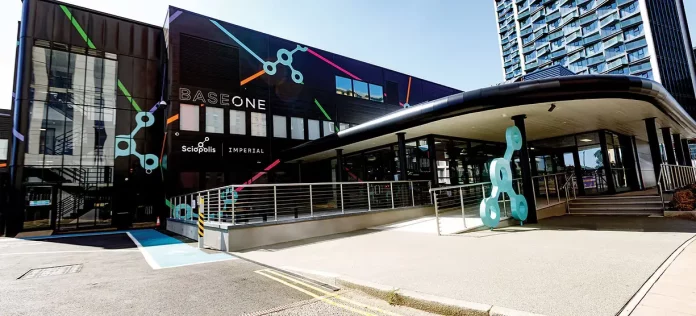
Imperial College London and Sciopolis have jointly launched Base One. This is a 55,000 sq ft innovation hub for advanced manufacturing and scaling deep-tech ventures in West London.
Base One provides affordable, ready-to-occupy laboratories and office space for scaling deep-tech businesses. Consequently, the facility solves a persistent “space problem” for growing UK science ventures transitioning from R&D into prototyping and early-stage manufacturing.
The site forms a key part of Imperial’s Old Oak Innovation Cluster within WestTech London. Furthermore, it sits directly alongside Grapht Works, Imperial’s dedicated facility for commercial-scale manufacturing. Together, the two sites create a seamless pathway for businesses to move directly from the lab bench to the factory floor.
Bridging the UK’s Scaling Gap
High-growth scientific companies in the UK have historically struggled to secure flexible, cost-effective industrial space. So, the Base One addresses this national bottleneck directly by offering adaptable workspace alongside technical and operational support.
Sector Agnostic: The hub welcomes scaling ventures across biotechnology, chemistry, cleantech, advanced materials, and artificial intelligence.
Strategic Ecosystem: Occupiers gain direct access to Imperial College London’s academic experts, STEMB graduate talent, specialist equipment, and investor networks.
On-Site Expertise: Imperial Incubator provides an on-site Lab Manager to support technical operations as companies scale production.
Strategic Location and Transport Connectivity
Base One sits adjacent to Park Royal Industrial Estate. This is London’s largest industrial zone, which employs over 40,000 people. Additionally, the site borders the Old Oak Common regeneration zone. The future Old Oak Common superhub will connect HS2, the Elizabeth Line, and Great Western Railway. Therefore, it will link West London directly to manufacturing and innovation clusters in Birmingham, Oxford, and Cambridge.
Highlighting the economic importance of the launch, Howard Dawber, Deputy Mayor for Business and Growth said: “West London is fast becoming a leading centre for science, technology and advanced manufacturing. Base One is a fantastic addition to the growing innovation cluster at Old Oak and Park Royal. Base One will help more businesses start, grow and scale in London.”
Hugh Brady, President of Imperial College London, added: “As we welcome Base One into WestTech London, we strengthen our contribution to the UK’s network of national innovation assets. Supporting a truly vibrant innovation ecosystem that’s competitive with the very best in the world. Starting from our base in West London, we are enabling a genuinely national asset, with strong links and partnerships to innovation clusters across the UK.”
Charlie Mitchell, CEO of Sciopolis said: “For too long high-growth companies have struggled to find the space they need to scale in the UK. We are responding to this pressing need by creating quality, affordable and read-to-occupy options that enable companies to remain in London. Base One and the wider Old Oak Innovation Cluster are a blueprint for advanced manufacturing in Britain.”
Anchor Occupiers Commercialising Deep Tech
Base One has already secured its first wave of high-growth occupiers moving into production:
Nanomox: A deep-tech company commercialising high-transparency zinc oxide for cosmetics, sunscreens, rubber, and electronics.
P.Happi®: A women’s intimate health brand manufacturing microbiome-focused healthcare products currently retailed in Boots.
Ki 13: An award-winning cleantech firm developing low-cost solutions to convert biomass into green hydrogen and biogenic CO2.
Reflecting on the move, Dr Francisco Malaret, Founder and CEO of Nanomox, said that Base One is “the only destination in London” that enables his firm to start manufacturing while remaining in an ecosystem built for their stage of growth.
In addition, Koji Muto, Co-founder and CEO of Ki 13, said that scaling out of the lab into hardware engineering for the first time is challenging. Hence, Base One and its adjacent industrial site will enable his team to co-locate with other innovators at similar stages. Subsequently they can share learnings, deliver the accessibility, affordability, and flexibility needed at a crucial growth phase.
Finally, Graham Hewson, Head of Incubation and Prototyping Space at Imperial College London, confirmed that Imperial Incubator is proud to have its Lab Manager onsite at Base One. He added that having backed early-stage companies from inception, Imperial can now support them through the delicate scaling stage as well, offering technical expertise as they take their next step.
Key Takeaways for Growth Hub Readers
Co-Location Advantages: Scaling hardware, cleantech, and materials ventures should seek space where R&D and pilot production can exist side by side. Consequently, reducing supply chain friction.
Leveraging Academic Ecosystems: Partnering with university-anchored clusters offers growing SMEs access to specialist talent, technical infrastructure, and founder networks.
National Innovation Supply Chains: Regional manufacturing firms can tap into London’s growing deep-tech pipeline as technologies move from urban lab hubs to broader UK industrial supply chains.