
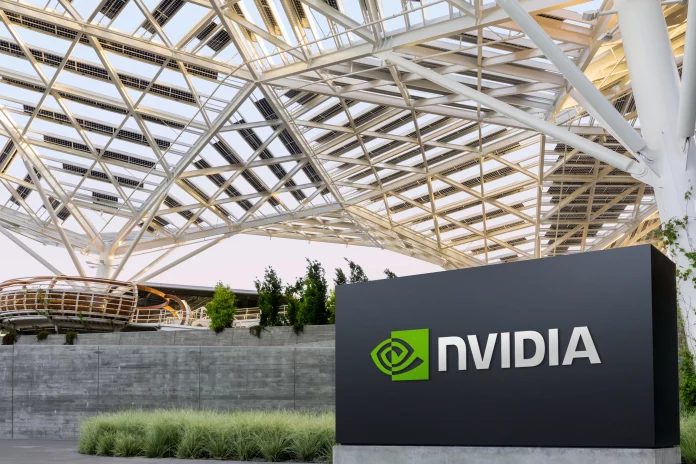
In a landmark financial move, NVIDIA has announced strategic partnerships with six of the world’s largest asset managers and private equity firms: Apollo, BlackRock, Blackstone, Brookfield, Goldman Sachs, and KKR. Together, the consortium aims to establish independent compute financing platforms to mobilise over $500 billion (£390 billion) of third-party capital for global AI infrastructure buildouts.
The memorandums of understanding create a formal mechanism to transform GPU compute power into a standardized, investable asset class. As a result, commercial enterprises, frontier AI laboratories, and specialised cloud providers will gain streamlined access to low-cost debt and long-duration capital tailored specifically to AI factory hardware and data centre operations.
Turning Compute into Infrastructure Capital
Traditionally, technology hardware has been treated as a rapidly depreciating corporate asset, creating significant liquidity and financing constraints for scaling tech firms. However, NVIDIA’s strategy reframes high-performance GPUs and CUDA-supported data centres as long-lived, revenue-generating infrastructure, much like power grids or telecom networks.
Because NVIDIA chips are versatile, transferable, and continuously updated via CUDA software, capital allocators can evaluate compute output as a predictable, usage-linked yield asset.
“We began by building chips; today, we are helping create a new class of productive, investable infrastructure: AI factories. In AI, compute is revenue… That is why we are bringing the world’s leading long-term capital providers together to independently underwrite AI infrastructure,”
said Jensen Huang, Founder and CEO, NVIDIA
Institutional leaders also emphasised the role of private credit in supporting macro-level economic growth.
Jim Zelter, President, Apollo said: “Modern compute has emerged as a scarce, mission-critical asset class with compelling investment characteristics that is positioned to drive significant long-term economic growth… The combination of NVIDIA’s technology ecosystem and Apollo’s flexible capital base provides a strong foundation for the next stage of the AI buildout.”
Commercial Takeaways for The Growth Hub Community
For UK technology leaders, financial directors, and enterprise strategists, NVIDIA’s novel financing model highlights critical shifts in technology commercialisation:
Lowering Capital Barriers for High-Scale Computing: Access to dedicated, asset-backed debt platforms allows scaling cloud operators and enterprise AI firms to secure expensive hardware without diluting equity or taking on direct vendor financing liabilities.
Separating Hardware Supply from Balance-Sheet Risk: By shifting debt underwriting entirely to third-party institutional funds, technology suppliers can maintain strong balance-sheet health while fueling customer adoption at massive scale.
Capitalising on Supply Chain Opportunities: The influx of $500 billion in private credit into physical data centres creates substantial downstream opportunities for components, power infrastructure, and advanced manufacturing providers across the tech ecosystem.