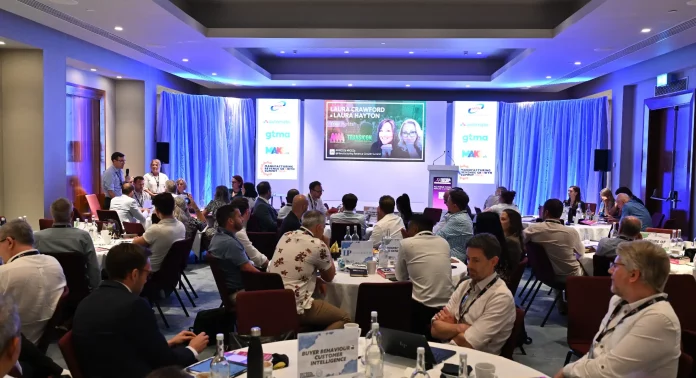
The afternoon breakout track at the London Leadership Edition of the National Sales Conference delivered a masterclass in modern commercial strategy. Hosted at the Hyatt Regency London Blackfriars, the Manufacturing Revenue Growth Summit brought together leading sales professionals. Pitch and communication coach Jenna Dominique chaired the specialist session.
The high-impact track blended advanced pitch craft, a data-led revenue playbook from sponsor Salesloft, and a highly practical look at AI-driven sales transformation. Ultimately, the day aimed to show how businesses can combine cutting-edge technology with the human touch to build long-term trust.
Superpower Pitching: Crafting the “Invisible Pitch”
To begin the summit, communication coach Jenna Dominique delivered an engaging keynote. She has coached over 2,000 startups to secure critical investment. Dominique argued that successful pitching depends entirely on the preparation you do before entering the room.
She summarised this preparation as three distinct “superpowers”:
- Curiosity: First, you must research your audience deeply. To help, she introduced a “mode of transport” framework for communication styles. Detail-driven Trains require step-by-step logic. Fast-paced Planes want the headline immediately. Relationship-focused Camper Vans or Boats connect with stories. Finally, energetic Rockets need space to explore big ideas. Successful presenters must identify their audience’s vehicle and pivot their delivery style to match.
- Clarity: Second, presenters must strip away dense corporate jargon. Dominique challenged the room to explain their complex products simply enough for a ten-year-old to understand.
- Creativity: Third, standard openings like “Welcome to the meeting” are incredibly forgettable. Instead, leaders should make creative choices. Using questions, stories, visual aids, or deliberate pauses will instantly capture attention.
Jenna Dominique noted: “It’s not what you see, it’s what you don’t see that makes the difference in a pitch. Your window of opportunity to capture attention is less than ten seconds.”
The Modern Sales Playbook: Raising the Bar on the Basics
Luke Richards, Regional VP at Salesloft, next shared a data-driven practitioner’s view of the modern B2B buyer. Richards revealed that 67% of buyers now actively avoid speaking directly to sales representatives. Furthermore, roughly half of all buyers use AI tools to vet vendors before any human interaction occurs.
Consequently, buyers still want to engage with sellers, but they do so much later in their purchasing journey. To avoid being irrelevant when that conversation finally happens, Richards outlined three consistent habits of top-performing sales professionals:
- Show Up with a Point of View: Because buyers are already highly researched, sellers should not just explain product features. Instead, they must bring a fresh perspective to the buyer’s unique business challenges.
- Interrogate What Happens Post-Meeting: Outstanding sellers immediately review the dynamics of a meeting. They identify missing stakeholders, confirm budget resources, and over-communicate to ensure downstream teams face zero surprises.
- Use AI for Legwork, Not Thinking: AI excels at conducting rapid prospect research. However, it cannot replace critical human thinking. The seller must still connect that research to the buyer’s actual situation.
Luke Richards explained: “AI is incredible… but it cannot form conviction. That’s what we need our salespeople to be doing.”
Real-World Takeaways from the Executive Roundtables
Between the keynotes, delegates gathered for interactive roundtable discussions. Under the Chatham House Rule, leaders shared several practical insights:
- System Onboarding: Consulting end-users before launching a new sales system significantly improves data quality and tool adoption down the line.
- The Shift to Quality: AI-powered prospecting must prioritize quality over quantity. Buyers easily spot and ignore generic, AI-generated email blasts.
- Overcoming Anxiety: Sales representatives quickly lose their fear of redundancy once they realize AI frees up their time. The technology automates busywork, allowing them to return to the valued role of a “craftsman” seller.
- Proven Results: One roundtable group reported that applying Salesloft’s post-meeting deal auditing framework successfully lifted their stage 2-to-3 pipeline conversion rate from 45% to 55%.
Five Crucial Shifts for Modern Revenue Teams
AI and innovation expert Julie Holmes closed the track with a highly tactical session. She detailed five concrete shifts reshaping how revenue teams operate:
- Shift 1: Rising Expectations: Using the story of Roger Bannister breaking the four-minute mile, Holmes showed how the “impossible” rapidly becomes the new baseline. Because buyers experience hyper-personalized service elsewhere, they now demand it from every B2B vendor. Leaders must audit what AI currently says about their brand, their competitors, and themselves.
- Shift 2: Context is King: Since everyone has access to the same AI models, your proprietary context is your only true differentiator. Teams must feed AI models with highly specific customer data and documented brand guidelines to generate high-value outputs.
- Shift 3: Reinvesting Saved Time: AI does not simply hand you free time; instead, it creates a “sandpile” that refills as fast as you empty it. Leaders should use a “delegation dial” to automate mechanical tasks, such as password resets. This automation successfully protects time for meaningful, emotionally invested client conversations.
- Shift 4: Leveraging AI Agents: Emerging AI agents can now handle complex, goal-oriented processes. Holmes shared how she used an agent to pull 18 months of newsletter statistics and compile them into a database automatically.
- Shift 5: The Second Age of Craftsmanship: Holmes cited Klarna’s decision to replace customer service teams with AI, which they later reversed to protect client satisfaction. Leaders must map their customer’s emotional journey and reserve human attention for the most critical touchpoints.
Julie Holmes warned: “The floor is rising… it’s easier to be good, and it’s never been less impressive to be good. Just because you can doesn’t mean you should.”