Would it surprise you to learn that the UK is now a global leader in manufacturing efficiency? For National Productivity Week, an annual initiative dedicated to highlighting the importance of productivity for the UK’s economic growth, new research from FourJaw Manufacturing Analytics reveals a quiet revolution happening across British factory floors.
After a difficult “lost decade,” the UK has emerged as one of the few major economies to deliver sustained improvements in both output and productivity.
From Decline to a Sharp Recovery
The research analysed manufacturing output and employment across the world’s largest manufacturing economies, focusing on those with output worth £500 billion or more.
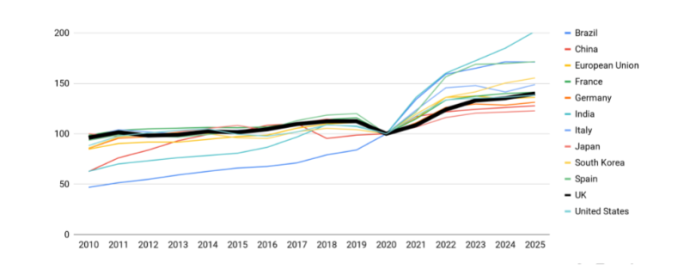
Between 2010 and 2019, the UK sector faced a 6% decline in real terms. During that period, the workforce actually grew by 5%. Consequently, productivity dropped by 10% because manufacturers were paying more people to produce less.
However, 2020 served as a vital reset. While COVID and Brexit caused an initial 12% decline, the rebound has been remarkable. By 2025, nominal output was 40% higher than in 2020. Significantly, this growth rate surpassed global competitors like Germany (+31%) and China (+28%).
Doing More with Less
The UK’s true distinction lies in output per worker. While many nations hired more staff to boost production, UK manufacturers raised output despite a 4% reduction in the workforce.
As a result, the UK achieved a 10% productivity rise since 2020.
In contrast, many key peers saw their productivity fall over the same period:
- France: -6%
- Germany: -5%
- United States: -0.5%
Ultimately, the UK’s efficiency is climbing the global ranks. In 2025, the UK produced £253k of output per worker, placing it behind only the US (£449k) and France (£339k) in terms of sheer efficiency.
Fueling the Modernisation
This turnaround is not a fluke. Instead, it is driven by a new spirit of innovation and massive investment in technology. Major projects are currently modernising the industrial landscape, including:
- Rolls-Royce: £2.6 billion for modular nuclear reactors.
- Sheffield Forgemasters: £1.3 billion for defence capabilities.
- Unilever: £80 million for a robotics-powered fragrance plant.
A New Industrial Narrative
The data from FourJaw is clear. The UK has moved from a “lost decade” into a period of high-velocity growth. By refreshing factory environments with productivity-boosting tech, the sector is shedding its old image. Ultimately, these investments ensure the UK remains a top-tier manufacturing powerhouse for years to come.