The era of “experimenting” with AI is officially over. According to Stanford’s 2026 AI Index report, AI agents have moved from a research project to a genuine business tool.
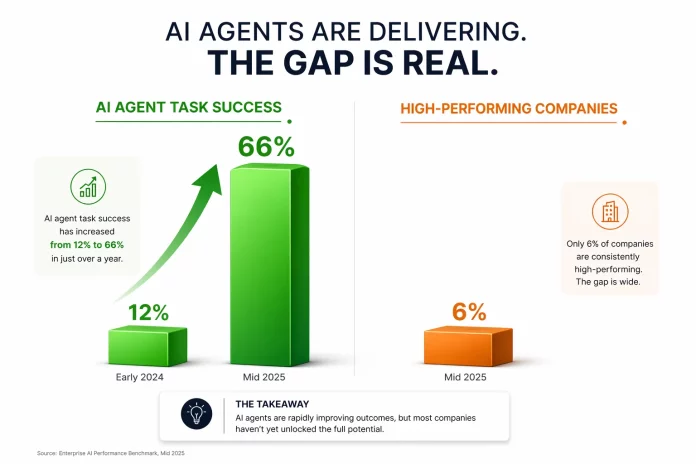
Remarkably, the success rate of AI agents on complex computer tasks jumped from 12% to 66% in just one year. This puts autonomous agents within six percentage points of human-level performance for tasks like navigating apps and completing multi-step workflows.
The 6% Club: Who is Actually Winning?
However, a massive “deployment gap” has emerged. While 88% of organisations claim to have adopted AI, very few are seeing a return on that investment. In fact, McKinsey reports that only 6% of companies qualify as “high performers.” These are the only firms seeing a meaningful impact on their bottom line.
Consequently, we are seeing a divide between companies that “play” with AI and those that “power” their business with it.
SMBs Are Being Left on the Bench
The gap is sharpest for small and mid-sized businesses (SMBs). Unlike global giants, SMBs rarely have dedicated engineering teams to build custom agents. As a result, while 76% of small businesses use AI, only 14% have integrated it into their daily operations.
Zilvinas Girenas, head of product at nexos.ai, believes the challenge has shifted. “It is no longer about whether the model is good enough,” Girenas explained. “It is about whether the people closest to the work can build and run agents themselves, safely, without waiting for IT.”
The Risk of ‘Shadow AI’
Because many firms lack a solid framework, employees are taking matters into their own hands. Alarmingly, Stanford recorded 362 major AI incidents in 2025—a 55% jump from the previous year.
This happens because teams often turn to consumer-grade tools on personal accounts. When workflows stay hidden from the business, risk increases and pilots stall. The successful companies in 2026 will be those that provide a “governed operating layer” rather than just another tool.
Moving from Chatbots to AI Agents
Ultimately, the shift defines 2026. AI is moving away from being an IT project and becoming an essential layer across sales, HR, and finance.
The game-changer is no longer about improving the models. Instead, it is about access. The winners will be the leaders who empower their business teams to create and manage their own AI tools.