
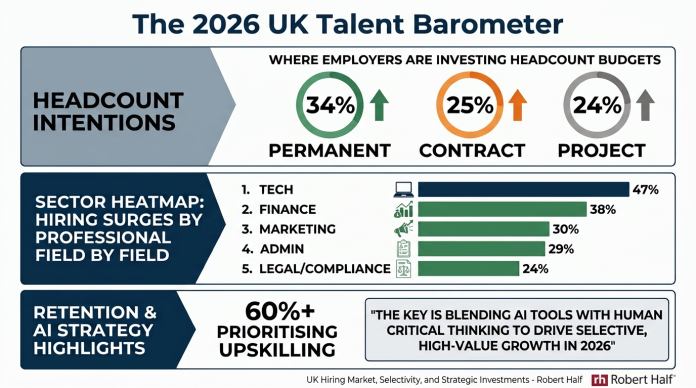
More than one-third (34%) of UK employers plan to expand their permanent workforce before the end of the year. In addition, new research from global talent consultancy Robert Half reveals that businesses are continuing to invest heavily in flexible staffing models.
According to the survey of 500 UK hiring managers, 25% of organisations plan to increase contract hiring. Meanwhile, 24% intend to expand project-based recruitment to maintain operational agility. Consequently, the findings suggest the recruitment landscape is becoming more selective rather than slowing down.
Sector Breakdown: Tech and Finance Lead the Charge
Employer demand remains strongest in high-specialism functions where talent shortages persist. For instance, nearly half of Technology & IT leaders plan to expand permanent teams to support digital transformation projects.
- Technology & IT: 47% plan to increase permanent hiring, 29% contract hiring, and 30% project-based hiring.
- Finance & Accounting: 38% plan to increase permanent hiring, 29% contract hiring, and 26% project-based hiring.
- Marketing & Creative: 30% plan to increase permanent hiring, 22% contract hiring, and 24% project-based hiring.
- Administrative & Office Support: 29% plan to increase permanent hiring, 25% contract hiring, and 22% project-based hiring.
- Legal, Risk & Compliance: 24% plan to increase permanent hiring, 20% contract hiring, and 19% project-based hiring.
Matt Weston, Senior Managing Director (UK & Ireland), Robert Half said: “Organisations are continuing to hire where skills are scarce, and talent can directly support strategic business objectives. Employers are taking a targeted approach to hiring, prioritising specialist talent and investing in workforce development.”
Upskilling and Human Skills in the Age of AI
To combat ongoing skill shortages, organisations are increasingly investing in internal development. Over six in 10 small-to-midsized enterprises (SMEs) and 64% of large firms identify training, upskilling, and reskilling as core retention strategies. Furthermore, 36% of employers plan to redesign existing job roles entirely.
In addition, while artificial intelligence continues to reshape day-to-day workflows, employers still place a high premium on human capabilities. Consequently, businesses are actively seeking professionals who combine technical proficiency with critical thinking, adaptability, and clear communication.
Commercial Takeaways
For business leaders, hiring managers, and growth-focused enterprises, Robert Half’s data provides actionable recruitment priorities:
- Adopt a Hybrid Workforce Strategy: Combining core permanent staff with agile contractors allows businesses to execute strategic growth initiatives without inflating long-term overheads.
- Focus on Upskilling Over External Sourcing: With 26% of employers expecting fiercer competition for specialist talent, investing in internal training programs reduces reliance on expensive external recruitment.
- Blend AI Fluency with Soft Skills: When recruiting technical or operational staff, evaluate candidates on critical thinking, stakeholder communication, and commercial judgment alongside technological literacy.