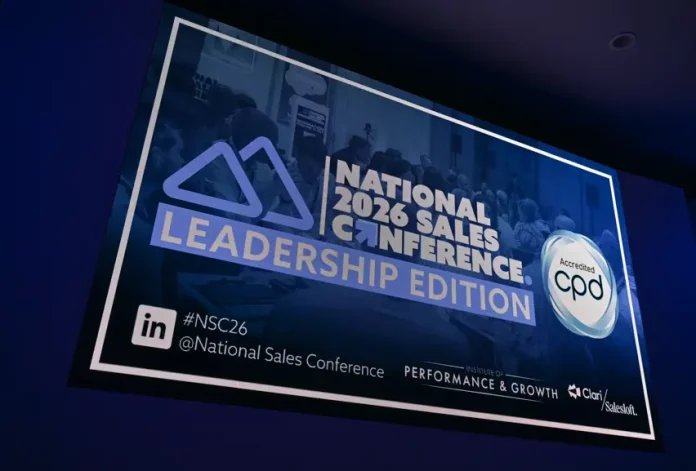
The London Leadership Edition of the National Sales Conference brought together top commercial leaders at the Hyatt Regency London Blackfriars. Chief Revenue Officers, sales directors, and VPs of sales gathered to discuss a vital theme. Specifically, leading people in a market being reshaped by AI. Pitch and communication coach Jenna Dominique hosted the event, which blended inspiring keynotes with Chatham House Rule roundtables.
Event Director Steve Lindsey started the day, highighting the defining themes. He focused heavily on talent attraction and retention. He also announced a major calendar change. The National Sales Conference will move to January 2027 in Birmingham. This shift positions the event as the UK’s unofficial sales kickoff. It will launch alongside a brand-new National Sales Academy for early-career professionals.
Cutting Through Ambiguity: The Next-Gen CEO Perspective
Media entrepreneur and scarer of The Apprentice candidates, Mike Soutar opened proceedings with a wide-ranging conversation on leadership. He drew on his extensive career transforming brands such as Kiss FM and the Evening Standard.
Soutar warned that ambiguity is the ultimate enemy of performance. When leaders avoid personal accountability, trust erodes rapidly. Therefore, leaders must hold themselves to the same standards as their teams. He said: “You have to measure yourself in a more disciplined way than you measure anybody else. It’s not the sin, it’s the cover up. It’s always when people try to cover up what they’ve done.”
Soutar’s several actionable strategies
- Categorise Your Decisions: He drew a sharp line between tactical and strategic choices. Tactical decisions are reversible. However, strategic ones act as one-way doors. Consequently, leaders should list their tasks, build momentum with quick tactical decisions, and save their energy for major strategic calls.
- Leverage Sales Insights: Salespeople stay closer to the market than anyone else. For this reason, businesses should treat feedback from the sales floor as a vital strategic asset. This feedback helps professionals escape being seen as just tactical.
- Lead Through Uncertainty: In a world with unknown outcomes, leaders can no longer lead by having all the answers. Instead, leading through values and being transparent about what you do not know are more durable tools. Soutar added: “Leadership is largely about leading people through uncertainty. That’s why that’s when people leave leaders, most of all.”
- Test for Constructive Dissent: Leaders must create a culture where people feel safe to disagree. To test this, Soutar suggested a simple question: “When was the last time you lost an argument internally?”
- Employ the PISA Framework: When delegating tasks, leaders can use the PISA acronym: Pause, It is not about you, Separate the issues from the noise, and ask “Am I the best person to solve this?” Usually, the answer is no.
- Protect Entry-Level Pathways: AI is rapidly eliminating traditional entry-level roles. Because of this trend, organisations must intentionally design structured career pathways for junior talent. They cannot simply rely on natural vacancies.
The AI Architect: Moving Beyond “Ordinary” Results
AI and innovation expert Julie Holmes delivered a powerful warning to the audience. She explained that AI makes it incredibly easy to achieve a good standard. However, generic outputs no longer differentiate a company. Holmes puts it: “Good has never been easier. It has also never been less impressive than it is today.” The real risk to modern sales organisations is not obsolescence, but becoming entirely ordinary. In her words: “The greatest risk that you face right now is not becoming obsolete, but instead becoming ordinary.”
Julie Holmes’ four-part framework for AI architecture
- Design on Purpose: First, teams need a short set of memorable AI principles. These principles must define what you believe about AI and where it belongs. For example, her team uses the rule: “AI does the work, but we are accountable for it.” Another core rule is: “We use AI when it raises the bar, not when it lowers it.”
- Build the Behaviour: Second, leaders must adopt a 20-60-20 model. Leaders define the strategy and direction (the first 20%). They can then let AI handle the mechanical creation (the middle 60%). Finally, humans must review, edit, and own the final output (the remaining 20%). She also recommended a weekly ten-minute “show and fail” ritual to normalise experimentation and surface shadow AI use.
- Coach Beyond the Basics: Third, managers must stop accepting generic AI prompts. Instead, teams should encode their unique sales methodology into bespoke internal tools, such as a custom prospect-research tool built around specific sales dimensions. Leaders must guide this process actively, because as Holmes noted: “We are no longer the font of knowledge. We are now the source of direction.”
- Decide the Line: Fourth, leaders must audit AI work constantly for absolute accuracy. They need to reserve human connection for critical moments in the sales lifecycle. She cautioned: “Just because you can doesn’t mean you should when it comes to AI.”
Ultimately, Holmes emphasised that tools cannot replace strong leadership, citing Gallup CEO Jon Clifton: “Even the most sophisticated neural network cannot overcome an indifferent team leader.” She believes the profession is entering a “second age of craftsmanship”. As technology raises the baseline of competence, human relationship-building becomes the premium differentiator.
Insights from the Executive Roundtables
The conference featured two rounds of interactive executive roundtables. Because these sessions operated under the Chatham House Rule, leaders shared their honest struggles and successes. Several consistent insights emerged across the tables:
- Informed but Misinformed Buyers: Modern buyers want to feel less sold to. They possess more information than ever before, but they also consume high amounts of misinformation.
- Quality Over Volume: High-volume prospecting is losing its effectiveness. Generic, AI-written outreach is incredibly easy to spot, so buyers quickly distrust it. Instead, teams must use technology to fuel highly targeted, insight-led outreach.
- The Evolving Remit of Enablement: Enablement teams are facing a massive shift in their responsibilities. They are moving away from simple training design and are becoming experts in AI adoption and change management.
- The Pace of Change: As cognitive load increases from new tech tools and faster product cycles, sales teams are feeling overwhelmed. Consequently, many professionals are asking their leaders to slow down the pace of change rather than accelerate it further.
- System Implementation: Consulting end-users before rolling out new sales systems significantly improves data quality down the line. This step avoids the ongoing challenge of siloed or finance-led data systems that do not serve sales needs.
Managing the Human Side of High Performance
The afternoon keynotes turned their focus toward human psychology and adaptability. Bestselling author Paul McGee delivered a masterclass on the human reaction to change. He noted that people do not automatically hate change; rather, they hate feeling out of control. Change feels safe only when people see the benefit or understand the cost of doing nothing. He urged leaders to “get comfortable feeling uncomfortable”. He also reminded the room that “the scariest place to be right now is in an organisation that’s not changing.”
He introduced the formula E+R=O (Event + Response = Outcome). We cannot always control the event, but our response completely dictates the final outcome. To manage stress, he urged leaders to swap fast, emotional “Red Cap” thinking for slower, rational “Blue Cap” analysis. He explained that this deliberate shift is vital because “stress makes you stupid.” When teams begin to catastrophise, leaders can use simple pressure-release questions, such as: “How important will this be in six months’ time?” Ultimately, he encouraged attendees to take action and “be the kind of person who says, I’m glad I did; not, I wish I had.”
Unashamedly Human: The Adaptive Leader
Closing this portion of the day, high-performance coach Jim Steele used a live memory exercise to show that human capability is often vastly underutilised. Leaders simply need the right system to unlock it. He outlined three essential qualities for adaptive leaders:
Better: Anchor your team’s vision in future potential, not just past results. An abstract vision, poorly communicated, breeds disengagement rather than motivation.
Smarter: Upgrade internal belief systems to match your goals. This upgrade is crucial because, as Steele noted: “The belief system seems to precede the behaviour.” He added: “It’s not what you believe, it’s what you need to believe in order to empower you to lean in.”
Stronger: Build resilience through voluntarily chosen challenges to strengthen your willpower and grit. Steele defined resilience as “the capacity to adapt and lean into difficult situations”. He noted that “the quicker you adapt, the less you have to endure.”
Steele concluded by urging the room to reframe technological disruption entirely. Leaders must actively flip the phrase “opportunities nowhere” into “opportunities now here”.
Stay tuned for the key takeaways from the Manufacturing Revenue Growth Summit, Revenue Growth Summit and Enablement Growth Summit, which took place on the same day. We will also bring you some exclusinve “From the NSC Stage” content from the London Edition very soon!