
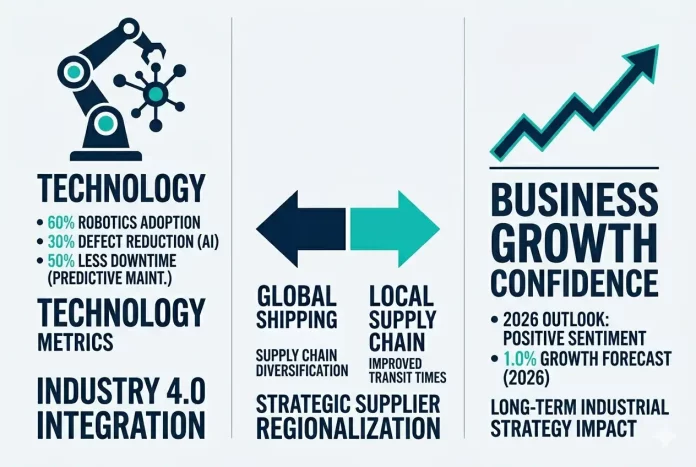
UK manufacturers are pivoting toward digital technology, automation, and generative AI. In particular, to shield their business operations from sustained inflationary pressures and the engineering skills shortage. According to the latest MHA Manufacturing Report, industrial leadership teams are facing a complex economic landscape. Specifically, raw input prices and supply chain volatility continue to test executive resilience. However, a distinct majority of sector operators remain highly optimistic about their long-term growth prospects.
This major sectoral shift directly mirrors the core operational strategies debated at Smart Manufacturing Week in Birmingham, where industrial leaders emphasised that digital transformation is no longer a luxury, but an essential shield against competitive displacement.
MHA Manufacturing Report: Shielding Margins Through Automation and AI
The most striking revelation in the research is how rapidly the industrial sector has embraced advanced technology to counter rising overheads. Instead of cutting back on capital expenditure, business owners are doubling down on workplace efficiency.
Specifically, investments in automation, robotics, and generative AI have moved from speculative boardroom theory into core operational reality. Enterprise operators are utilizing predictive AI tools to forecast component demand, optimize factory floor workflows, and manage raw material constraints.
Importantly, this technological surge is directly driven by the domestic skills crisis. With qualified technical talent increasingly difficult to attract and retain, automation serves as a vital tool to sustain production output without dramatically inflating human resource overheads.
Supply Chain Reshoring Regains Momentum
The report highlights that the globalization model for industrial components is continuing to fragment. Following years of shipping delays, geopolitical friction, and rising freight overheads, UK firms are actively bringing their supply networks closer to home.
Furthermore, this nearshoring strategy is helping companies secure their working capital. By reducing transit times for vital parts, production managers can keep lower levels of inventory on hand, freeing up vital cash flow that would otherwise be locked up in warehouse storage or transit.
Despite these ongoing structural overhauls, overall sector optimism remains remarkably robust. Executive teams are projecting strong revenue pipelines for the remainder of the year, banking on their upgraded digital infrastructure to help them win and retain premium commercial contracts.
Navigating the Energy and Green Transition
Beyond technology and staffing, the green transition continues to dominate executive thinking. However, the path to net-zero is proving to be a difficult balancing act for mid-market operators.
“UK manufacturers are showing incredible resilience, but they are walking an absolute tightrope between managing immediate input costs and investing in the long-term green transition,” notes the sectoral analysis. “Firms are clearly recognizing that energy efficiency is no longer just a compliance box to tick, it is a direct driver of business performance and margin protection in today’s market.”
The Bottom Line for Commercial Leadership
For commercial directors and business owners looking to scale their operational footprint this year, the message from the MHA research is clear. Therefore, if you are planning to expand your production volume, you must ensure your digital backend can support that growth.
Ultimately, trying to scale a manufacturing business using legacy, siloed processes is an extreme risk. Audit your existing shop-floor workflows today, evaluate where automation can alleviate your staffing bottlenecks, and ensure your sales pipeline is tightly aligned with your actual production capacity to protect your bottom line.